Intuition vs Anxiety:
Trust Your Gut and Make Clear Decisions

Author: Alex Guru | Reading time: 6 minutes

Engraving of a traveller with a compass in the fog, symbolising intuition as an inner navigation tool.

'Follow your heart,' 'trust your gut' — we hear this advice all the time. But when it comes to making a genuinely difficult decision — whether to quit or stay, invest or hold back, trust someone or not — our inner voice starts to feel unreliable. We can't tell: is this a warning from somewhere deep within, or just our own anxiety? Is it wisdom speaking, or old wounds resurfacing?

The Inner Compass (intuition) is not some mystical gift reserved for a chosen few. It is a precise navigational instrument of your mind — what we call a Firm Positive Preference in our system. It is your brain's ability to process vast amounts of data and deliver an instant, compressed answer in the form of a clear impulse.

In this article, we'll break down how intuition actually works, learn to tell it apart from fear, and explore practical exercises for tuning your inner navigator. You'll come to understand that intuition is your brain's rapid Big Data processing (neuroscience) — and that specific regions of the brain are responsible for it.

How Intuition Works in the Brain:
Your Unconscious Pattern-Recognition System

To understand how to hear your inner voice, you need to stop thinking of it as magic. Let's look at it through an engineer's eyes.

Every single second, your senses and brain absorb millions of pieces of information: the microexpressions on someone's face, their tone of voice, subtle smells, atmospheric pressure, your own past experience in similar situations. Your rational, conscious mind — your 'working memory' — can process only a tiny fraction of this stream: roughly 5 to 7 units at a time.

Where does the rest go? It is processed by your subconscious — an extraordinarily powerful biological supercomputer.

Intuition

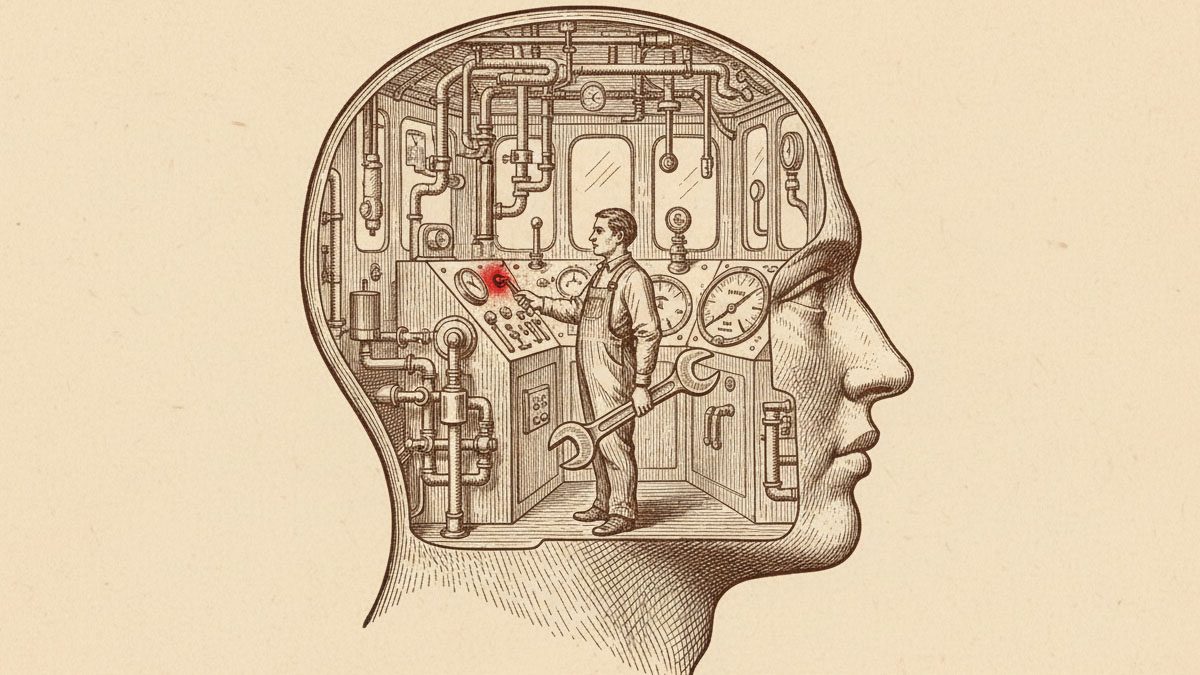
Engraving of a machine processing a vast stream of data into a single signal, symbolising how the subconscious works.

Intuition is the final report from this supercomputer. It doesn't hand you long spreadsheets full of analysis. It gives you a signal.

  • If the forecast is positive, you feel a sense of expansion, curiosity, and a gentle excitement.
  • If the forecast signals danger, you feel a tightening and a coldness inside.

The challenge for most people today is that there is relentless noise inside their heads. The loud voices of fear and logic drown out the quiet signal from the supercomputer. This endless internal chatter — mental rumination — creates interference that blocks the guidance your subconscious is trying to send.

Intuition is not magic — it's mathematics. It is pattern recognition.

Where does that 'gut feeling' actually come from?

Neuroscience tells us: the brain is a prediction machine.

  • The basal ganglia (one of the brain's most ancient structures) store terabytes of your accumulated life experience.
  • When you encounter a new situation, your brain compares it against this archive in nanoseconds.
  • If the pattern matches a past success — dopamine is released (excitement / interest).
  • If the pattern matches a past painful experience — cortisol is released (tightening / anxiety).

The takeaway:
Intuition is a compressed archive of your life experience, unpacked in 0.1 seconds.

The Key Sign of True Intuition:
Calm, Clear Positive Pull (Not Pressure)

Engraving of a magnet aligning iron filings, symbolising desires organising around a true inner goal.

In the course 'Life at a Higher Frequency,' we use a precise definition of intuition — we call it a Firm Positive Preference.

This is not the chaotic back-and-forth of 'I want it — no, I don't.' It is a stable structure — a 'crystal' — that forms in your consciousness from three elements:

  1. Memory:
    You can recall experiences of joy and success in similar situations.
  2. Desire:
    You feel drawn toward this option — there is energy behind it.
  3. Certainty:
    A deep, quiet knowing that 'this is the right direction for me.'

When these three elements align, your Inner Compass (intuition) comes to life. It works like a magnetic needle: it may tremble, but it always turns, inevitably, in one direction — toward your growth and fullest potential.

Intuition vs Fear:
9 Signs You’re Feeling Anxiety, Not Inner Guidance

This is the most common question:

'I don't want to go to that meeting — is my intuition protecting me, or is it just my fear of something new?'

The difference lies in the quality of the signal.

Comparison of a panicking figure and a calm, composed figure, symbolising the difference between fear and intuition.

The Fear Signal (False Alarm):

  • Volume:
    It shouts, panics, and demands an immediate reaction.
  • Direction:
    'Away FROM.' The urge to hide, avoid, or do nothing.
  • Physical sensation:
    Tightening, tension in the stomach or shoulders, coldness, heaviness.
  • Emotional tone:
    Anxiety, restlessness, doubt ('What if it doesn't work out?').

The Intuition Signal (True Compass):

  • Volume:
    A quiet, calm, assured voice. It doesn't argue — it simply knows.
  • Direction:
    'Moving TOWARD.' Even when intuition says 'don't do this,' it points toward an alternative — somewhere to go instead.
  • Physical sensation:
    Openness, lightness, warmth. (To learn how to pick up on these subtle signals, you need to develop the skill of body awareness — and stop living entirely in your head.)
  • Emotional tone:
    Clarity. Even when the decision feels risky, there is a calm readiness underneath.

A Simple Test:

If you feel drama and inner turmoil — that's fear. If you feel a quiet, dry clarity (even an uncomfortable one) — that's intuition.

Neuroscientist Antonio Damasio demonstrated:
The body 'knows' the right answer before the mind does.

  • In card experiments, players' palms began to sweat when they reached for a losing deck — long before they consciously understood the deck was bad.
  • Your task is to calibrate these micro-signals (sweaty palms, a flutter in the chest) rather than ignore them.

Quick Self-Check:
Is This Your Inner Wisdom or a Fear-Based Reaction?

A clear checklist to evaluate yourself in this very moment.

Table: 'Intuition vs Paranoia'

Parameter
🧘 True Intuition (Signal)
😱 Anxiety / Paranoia (Noise)

Sound

A quiet, calm voice — almost a whisper.

A loud, frantic shout.

Emotional charge

Neutral or mildly curious.

Panic, drama, 'everything is falling apart.'

Time orientation

A sense of 'here and now.'

Projecting into a frightening future ('But what if...?').

Duration

A brief impulse — a flash.

An obsessive loop — mental rumination.

Physical response

Relaxation / Openness.

Tension / Tightening / Trembling.

How to Strengthen Your Intuition:
Practical Exercises for Better Decisions

Engraving of a diver finding a pearl on the ocean floor, symbolising the search for answers in the depths of inner stillness.

Like a muscle, intuition can be trained and strengthened. Here are three techniques from our practice.

1. The 'Question Into Silence' Practice

To hear the quiet signal, you need to turn off the noise.

  1. Sit down and close your eyes. Use the 'Emergency Stop' technique (from Course 3) to bring the flow of thoughts to a halt.
  2. Create an inner stillness.
  3. Pose your question clearly (for example: 'Should I take on this project?').
  4. Don't think. Listen for the first response. It may come as an image, a word, or a physical sensation (tightening or expansion). The first 1–2 seconds are intuition. Everything that follows is the mind at work.

2. The 'Yes/No' Calibration

You need to learn the language your body speaks.

  • Recall a decision that was clearly a mistake. Immerse yourself in that moment. Where in your body does discomfort appear? What does your personal 'No' feel like?
  • Recall a decision that was 100% right. How did your body respond then? Was it warmth in the chest, or a tingle down your spine? That is your personal 'Yes.'
    Use these markers as your reference points going forward.

3. The Anticipation Test

Before making a decision, ask yourself: 'Is there any energy here?'

Intuition always leads toward where life is. If thinking about an option brings up boredom, heaviness, or a sense of 'I have to' — your Compass is telling you there's no fuel there. If there's even a flicker of excitement or curiosity (even alongside fear) — the needle is pointing the right way. This is the hallmark of a true Battery Desire — the kind that will give you the energy to actually follow through.

A Decision Filter:
The 10-10-10 Method

Biohack: The '10-10-10 Rule' (Suzy Welch) — a time-testing algorithm for your decisions. It cuts through impulsive fear instantly.

Fear only lives in the moment. Intuition sees the bigger picture.

When in doubt, ask yourself:

  • How will I feel about this decision in 10 minutes? (Fear says: 'It will feel scary or embarrassing').
  • In 10 months? (Intuition says: 'I'll be proud I went for it').
  • In 10 years? (Intuition says: 'This will change the entire direction of my life').

If the decision still feels right from a 10-year perspective — that's Intuition speaking. If it only feels frightening in the first 10 minutes — that's simply your comfort zone pushing back.

Life Hack:
'Heads or Tails'

Practice: 'The Coin Flip' (Accessing Your Subconscious) — this is the key technique.

When logic has hit a dead end, flip a coin.

The secret: Don't look at the result.

In the split second the coin is in the air, your subconscious already knows which outcome it wants.

  • If you find yourself hoping for Heads — that's your Intuition.
  • If the coin lands on Tails and you feel a pang of disappointment — your Intuition was rooting for Heads all along.
  • 'Sometimes Intuition goes quiet because the fear is simply too overwhelming. First, try the Plan B Technique to bring your fear level down — and the signal will become clear'.
  • 'Mental noise is intuition's greatest enemy. Learn how to silence it in the article How to Stop the Inner Dialogue'.
  • 'Intuition speaks through the body (somatic markers). If you're disconnected from your body, you're deaf to your intuition. See the article 'Living in Your Head''.

How to Find Your Inner Compass:
Creating Silence to Hear Your Gut Feeling

Intuition is not a luxury — it is a fundamental navigation tool for moving through a complex world. Without it, you are flying blind. But for it to work at full capacity, you need to move from a 'fluid' state of mind (doubt, indecision) to a 'crystalline' one (clarity, a firm sense of direction).

Intuition is not the voice of spirits — it is your brain processing vast amounts of Big Data and delivering a report. And you can learn to hear that report clearly.

How do you grow that crystal within yourself? How do you get your inner Compass working in real time — warning you of wrong turns before you make them?

The complete step-by-step method for building your own navigation system is laid out in the premium Lesson: The Birth of the Compass.

Go to the lesson and start turning vague gut feelings into a precise system for navigating your life.