How to Get Into a Flow State:
Science, Samadhi, and Clear Thinking

Author: Alex Guru | Reading time: 7 minutes

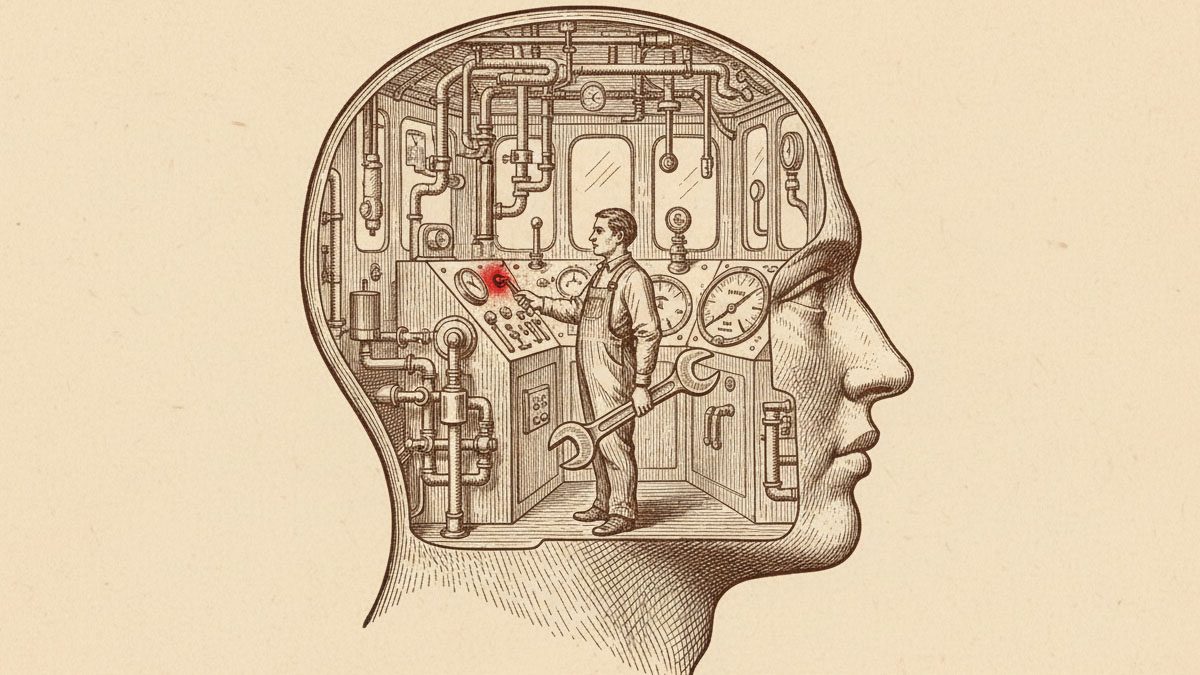
Engraving of a conductor commanding the forces of nature — a metaphor for mastering flow state and samadhi.

Musicians call it 'being in the groove', athletes call it 'the zone', psychologists call it flow state, and mystics call it samadhi or satori. These are moments of absolute clarity — when time dissolves, the sense of 'self' falls away, and everything you do feels effortless and perfect.

We tend to treat these peak experiences as rare gifts from the universe, or as rewards for decades of dedicated practice. We wait for them like miracles, hoping inspiration will strike or the heavens will open.

At the 'Consciousness Workshop', we take a different approach. We look at these states through an engineer's eyes. For us, Nirvana or Flow is not mysticism — it's a distinct, high-performance mode of consciousness. It's a complex 'emotional chord' that you don't have to stumble upon by chance. You can learn to build it deliberately.

This article is your entry point into the 'Premier League' of personal development. The topic of Flow State has been brought into the mainstream by Mihaly Csikszentmihalyi and Steven Kotler.

  • In this article, we explain these mystical states — Nirvana, Flow, Samadhi, Satori — as operating modes of a neural network.
  • You'll understand that 'ego dissolution' is not the death of your personality — it's the temporary deactivation of a specific region of the brain to conserve energy.

🛡 Safety Disclaimer:
Who Should Avoid Intensive Flow and Meditation Practices

The techniques described here — disidentification, stopping the inner dialogue, working with inner stillness — are powerful tools that significantly affect the psyche.

Contraindications:
Clinical depression, psychiatric conditions (schizophrenia, bipolar disorder, psychosis), or use of strong psychotropic medications. If you are under psychiatric care, only practice these techniques with your doctor's explicit approval.

If you experience strong anxiety or emotional destabilisation during practice — stop immediately and ground yourself.

Expert insight:

Flow isn't just 'pleasant'. It's the state in which a person becomes superhuman. Learning speed increases by 400%, creativity by 200%. It's the only legal performance-enhancing drug that actually works.

Steven Kotler, neuroscience researcher and peak performance expert, founder of the Flow Research Collective. He translated the concept of Flow from the language of mysticism into the language of Silicon Valley.

Flow State Breakdown:
Key Elements of Peak Performance and Samadhi

Engraving of a master tuning a vast pipe organ — a metaphor for synchronising all aspects of consciousness into one harmonious chord.

To understand how to enter a flow state, you first need to stop seeing it as magic and break it down into its components.

Think of your consciousness as an orchestra. Normally, the instruments play out of sync: the violin (your thoughts) is fretting about a work problem — that relentless mental noise we call 'Mental Rumination' — the drums (your body) are thumping out a rhythm of anxiety, and the trumpet (your desires) is demanding distraction. That is the ordinary human condition: noise and chaos.

Living in flow is the moment when the entire orchestra begins playing one symphony in perfect harmony.

From the perspective of 'State Architecture' — our core methodology — every peak experience is an 'Emotional Chord' composed of several pure notes:

  1. High Energy: You feel powerful, but not tense.
  2. Total Focus: Your attention is completely 'locked onto' the present moment (high 'Magnetism').
  3. Zero Resistance: There is no inner conflict, no self-doubt, no 'brakes' in the form of fear or procrastination.

Samadhi is the deepest degree of this concentration — the point at which even the observer disappears, leaving only the pure process of awareness itself.

The Entry Formula:
The 4% Rule

Tool: The 'Flow Channel' (Challenge-Skill Balance) — the cornerstone of Csikszentmihalyi's theory.

Mihaly Csikszentmihalyi identified the formula: Flow only arises in a narrow corridor between Boredom and Anxiety.

  • Boredom: The task is too easy for your current skill level.
  • Anxiety: The task is overwhelming.
  • Flow: The task is just 4% harder than your current abilities.

The engineering challenge:
To enter flow, you need to either deliberately stretch a task that feels too easy, or break down an overwhelming one into smaller, manageable steps.

Transient Hypofrontality is the leading neuroscientific explanation for why the sense of 'self' disappears in Flow.

Where does the 'I' go during Flow?

This phenomenon is known as Transient Hypofrontality — a temporary quieting of the prefrontal cortex.

  • The prefrontal cortex governs our sense of time, logical reasoning, and self-criticism (the inner critic).
  • Under peak cognitive or physical load, the brain dials down this region in order to redirect 100% of its energy to sensory processing and performance.

The takeaway:
The feeling of 'merging with the universe' is not mystical. It's the hardware-level deactivation of the module responsible for separating 'self' from 'everything else'.

Self-Assessment:
Are You in Flow, Anxiety, Boredom, or Overthinking

People often confuse Flow and Samadhi. The table below shows you the key difference between an active state and a receptive one.

Table: 'Flow vs Samadhi'

Parameter
🌊 Flow State
🧘 Samadhi (Pure Awareness)

Type of Action

Active (running, coding, negotiating).

Passive (meditation, contemplation).

Direction

Outward (solving a problem).

Inward (dissolution of the observer).

Neurochemistry

Dopamine + Noradrenaline (Drive).

Serotonin + Oxytocin + GABA (Calm).

Brain Waves

Alpha-Theta bridge (Creativity).

Gamma synchronisation (Superconsciousness).

Outcome

Brilliant output or creation.

Profound personal transformation.

Why You Lose Flow:
Common Triggers That Break Focus and Presence

Engraving of resonating lutes — a metaphor for creating flow through resonance rather than willpower.

The most common mistake is trying to force flow through sheer willpower. (For more on why this resource is limited and so often lets us down, read Why Willpower Doesn't Work.) But flow is not about pushing harder — it's about removing resistance.

In Course 7, we explain this through the metaphor of resonance. You can't make a string vibrate by shouting at it. But you can tune the string next to it so that it begins to resonate in harmony.

You fall out of flow because:

  • There's 'noise':
    Unresolved negative emotions (background anxiety) create interference that drowns out the signal.
  • There's no 'chord':
    You're trying to play the piece 'with one finger' — relying on willpower alone — instead of engaging the full spectrum of higher emotions: curiosity, anticipation, and joy.

How to Enter Flow on Demand:
Practical Tools for Controlling What You Can’t

Engraving of an alchemist creating a luminous substance from raw components — a metaphor for building an emotional chord.

In transpersonal psychology, these states are frequently described, but rarely comes with a clear 'how-to'. We offer an engineering-based algorithm instead.

To make peak experiences happen on demand, you need to master the art of building 'Emotional Chords'.

1. Clear the signal:

Start by applying foundational techniques to dissolve negativity. You cannot build a cathedral on a swamp.

2. Choose your root note:

Consciously cultivate one clear, strong inner state. For example, Curiosity or a Sense of Mystery.

3. Add the overtones:

Layer in additional qualities — Body Awareness (physical calm) and Mental Clarity.

4. Synchronise:

When these states begin to resonate together, a synergy emerges. The sum of the parts gives birth to something new — the Flow itself.

You are not 'waiting' for inspiration. You are assembling it, piece by piece, from the elements already available to you.

Flow is the most potent cocktail your brain can mix:

  1. Noradrenaline: Sharpens attention and focus.
  2. Dopamine: Pattern recognition and the thrill of the chase.
  3. Anandamide: Lateral, out-of-the-box thinking.
  4. Endorphins: Suppresses physical discomfort.
  5. Serotonin: The afterglow of deep satisfaction.

Our methodology teaches you to trigger these neurochemicals in sequence, assembling the full 'Chord'.

  • 'Hypofrontality (Flow) automatically silences the Inner Dialogue, because the brain's speech centres are effectively powered down.'
  • 'Anandamide — the bliss molecule — is also released through the practice of savouring. See The Art of Pleasure.'
  • 'Samadhi and Lucid Dreaming share the same fundamental nature — they are both states of conscious awareness with the body switched off.'
  • 'Only those who have developed a strong Inner Core can sustain the intensity of Flow for any length of time.'

Designing Peak Experiences:
A Repeatable System to Trigger Flow More Often

Engraving of an architect building a temple in the clouds — a metaphor for consciously constructing higher states of awareness.

A true master doesn't rely on luck. They understand that Nirvana is not a place you arrive at after death, but a quality of conscious awareness available here and now.

If you're ready to stop being a 'tourist' in the realm of higher states and become their 'architect', you need to learn to see the structure of your own inner experience. You need to understand how to weave simple emotions into complex, powerful symphonies.

This knowledge exists. We call it «The Alchemy of Consciousness».

Want to learn how to take simple 'notes' — joy, curiosity, stillness — and compose powerful 'chords' of flow and inspiration?

Explore the method in the full Lesson: Beyond a Single Note: What Are 'Emotional Chords' and How Do They Arise.

Stop waiting for a miracle. Design one.