Cognitive Biases and Mental Traps That Hijack Your Decisions

Author: Alex Guru | Reading time: 8 minutes

Engraving of an artist drawing a distorted reality through warped glass — metaphor for cognitive biases and mental traps

You think of yourself as a rational person. You're convinced that your decisions — from choosing a yoghurt to choosing a partner — are grounded in logic and common sense. You believe your views are the product of careful analysis, and your fears are justified by real threats.

Here's some uncomfortable news.
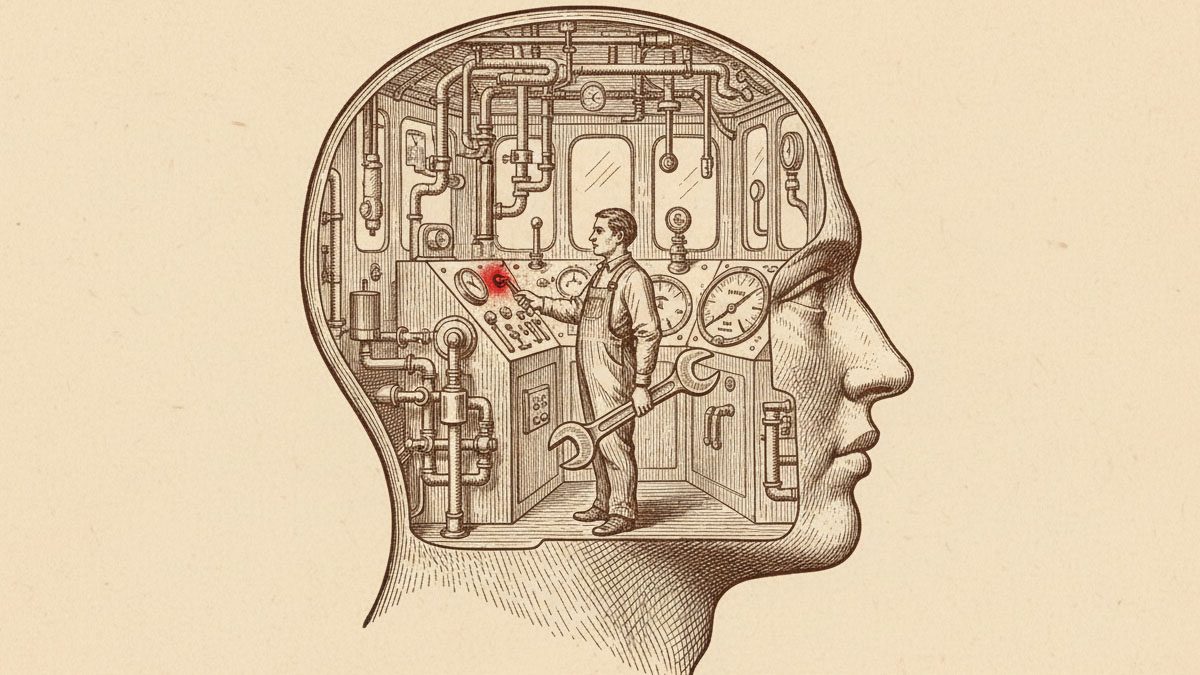
From a neuroscience and mind-engineering perspective, you're not actually thinking 99% of the time. You're simply running pre-loaded scripts. (For a deeper look at the architecture of this 'bio-computer' and its layers, see our guide The User Manual for Your Mind That Nobody Gave You.)

You are a bio-computer operating in strict energy-saving mode. And to preserve that energy, your brain is constantly cutting corners, substituting facts, and generating illusions that you accept as reality.

In this article, we'll break down what cognitive biases actually are, why even the sharpest people make the most baffling thinking errors, and how to override this 'faulty autopilot' so you can start making truly sound decisions.

Autopilot Thinking Explained:
Why You Live in “Zombie Mode”

Engraving of a sleeping helmsman on a ship — metaphor for living on autopilot and lack of conscious control

Let's look at the architecture of your thinking. Conscious thought is the most energy-intensive process your body performs. If you genuinely deliberated over every action, you'd be mentally exhausted before lunchtime.

So nature built in a shortcut. In the 'Mind Workshop' method, we identify two operating modes of the brain:

1. 'Autopilot' Mode (99% of the time):

Fast, automatic reactions. The brain doesn't analyse the situation — it retrieves a template from past experience.

Example:
You spot a red sale tag and buy something without thinking. You hear criticism and feel hurt.

2. 'Pilot' Mode (1% of the time):

Slow, deliberate, critical thinking. It requires conscious effort and willpower.

Why do we make mistakes?

Because we use 'Autopilot' where 'Pilot' is required. We try to solve complex life problems using primitive, outdated templates. A striking example of this breakdown is Impostor Syndrome — where the brain ignores all evidence of your success and keeps running the old script: 'I'm not good enough.' It's like trying to pilot a spacecraft with a TV remote.

Charlie Munger, legendary investor and Warren Buffett's long-time partner, referred to cognitive biases as 'The Psychology of Human Misjudgement.'

He coined the concept of the Lollapalooza Effect: when 3–4 biases operate simultaneously (for example, Social Proof + Scarcity + Authority), the brain shuts down entirely.

  • This is precisely how cults, Ponzi schemes, and flash sales work.

Bottom line:
If you feel an overwhelming urge to do something reckless, chances are you're caught in a Lollapalooza moment.

Evolutionary Psychology of Bias:
Why Your Brain Uses Shortcuts

Why did evolution leave us with these errors? They're not signs of stupidity — they're outdated survival code.

Table: 'Bug vs Feature'

Bias
🦁 Why was this useful in the cave?
🏢 Why does it backfire in the modern world?

Negativity Bias

To spot the tiger in the bushes (survival).

Doom-scrolling the news, chronic anxiety, dismissing the positive.

Black-and-White Thinking

To instantly identify friend from foe.

Polarised opinions, inability to compromise, conflict.

The Endowment Effect

To defend your food and territory.

Inability to sell old possessions or walk away from a failing business.

Survivorship Bias

To copy the behaviour of successful leaders.

Belief in effortless success ('Dropped out of school — became a millionaire').

The 3 Most Common Cognitive Biases (And How They Trick You)

Your 'Autopilot' is riddled with bugs. Psychologists call them cognitive biases — systematic errors in perception that distort reality. Here are the most dangerous ones:

1. The Confirmation Trap ('The Filter Bubble')

Engraving of a person wearing blinders, unable to see the world around them — metaphor for confirmation bias and ignoring contradictory facts

Your brain literally filters out facts that contradict your existing beliefs.

  • Example:
    You believe all wealthy people are corrupt. You'll notice every story about a dishonest official in the news — but your brain will quietly 'filter out' the story of an honest entrepreneur who built something from nothing.
  • Result:
    You don't live in reality — you live in a self-confirming hallucination built from your own assumptions. These assumptions are the invisible skeleton of your identity. (Learn how to uncover them in the article Brain Antivirus: How to Find Your Hidden Beliefs.)

Confirmation bias is the 'mother of all cognitive errors'.

  • Your brain operates like a search engine with a hard-coded filter. If you believe that 'all men are jerks', your internal Google will keep serving up jerks in the results — while quietly burying the decent ones on page ten.

2. The Sunk Cost Effect

Engraving of a drowning man refusing to let go of a heavy chest — metaphor for the sunk cost fallacy and inability to cut losses

The more resources — time, money, emotional energy — you've invested in a mistake, the harder it becomes to admit it was a mistake.

  • Example:
    You keep propping up a failing project, staying in a dead-end relationship, or forcing yourself to finish a tedious book because you've 'already put so much into it.'
  • Result:
    You sacrifice your future trying to rescue your past.

3. Social Proof ('The Herd Instinct')

In situations of uncertainty, the brain switches off critical thinking and simply mimics what the majority is doing.

  • Example:
    Everyone rushes to stock up on pasta and bottled water — so you do too. Everyone says a film is a masterpiece — so you search for deeper meaning in it, afraid of looking out of touch.
  • Result:
    You end up living not your own life, but the average script of the crowd.

How to Switch From Autopilot to Conscious Thinking in Minutes

Engraving of a judge stopping a messenger for verification — metaphor for critical thinking and pausing automatic reactions

You can't delete 'Autopilot' — you need it to function. But you can take back the controls at the moments that matter most.

To do that, you need to master the skill of the 'Autopilot Detector.'

The Reality Check Algorithm:

  1. Catch the instant reaction.
    When you feel the urge to argue with someone, make a purchase, or snap to a decision — pause. Ask yourself: did this impulse appear in a split second? If yes, that's the Autopilot talking.
  2. Create a gap.
    Real thinking takes time. If you have a ready answer within one second, that's not a thought — it's a template.
  3. Ask a control question.

    • 'Is this actually my opinion, or did I absorb it from somewhere?'
    • 'What facts — not feelings — support this decision?'
    • 'If I hadn't already invested so much in this, would I choose to start it today?'

This process flips the switch from emotion to logic.

Technique: The 'Devil's Advocate' (Pre-Mortem)

Before committing to an important decision that feels like a sure thing, force yourself to identify 3 reasons why it could be a complete failure.

  1. Imagine that a year has passed and your project has collapsed spectacularly.
  2. Write the story: why did it happen?
  • 'We underestimated the competition.'
  • 'I overestimated my own capacity.'

This is the only reliable way to forcibly engage critical thinking (System 2) when you're blinded by optimism.

  • 'Cognitive biases are the mechanisms that protect your Blind Beliefs from being dismantled by facts.'
  • 'To learn more about how "System 1" (Autopilot) and "System 2" (Pilot) work, read the User Manual for Your Mind.'
  • 'Hyperbolic discounting is the bias that drives Procrastination.'

Never attribute to malice what can be adequately explained by thoughtlessness.

When someone cuts you off in traffic or leaves your message on read, your Autopilot shouts: 'They have no respect for me!'

  • Apply Hanlon's Razor:
    'They were probably just tired, distracted, or didn't notice.'

Result:
The anger dissolves. The cortisol spike never comes.

Quick Start Guide:
What to Do Right Now to Think Clearly

Admitting that you don't know how to think is painful for the ego. But it's the first step toward intellectual freedom. Until you can see your own mental traps, you're a puppet of your instincts and other people's manipulation.

In the free Lesson 'Do We Actually Know How to Think? The Truth About How Our Brain Deceives Us', we put your thinking through a rigorous stress test.

You will discover:

  • How to tell your own genuine thoughts apart from a 'mind virus'.
  • Why intelligent people so often make the most foolish decisions.
  • Your first practical steps toward switching into 'Pilot' mode.

Stop living on autopilot. Take back the controls.