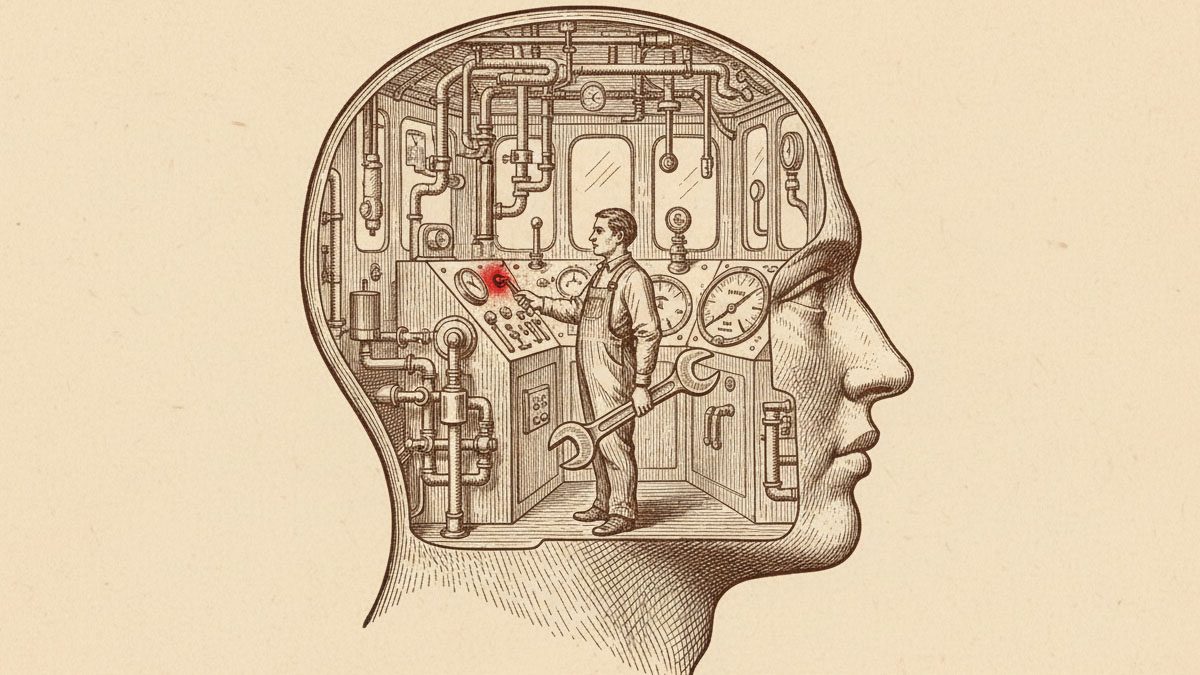
How to Rewire Your Mind:
Practical Techniques for Clear Thinking

Author: Alex Guru | Reading time: 12 minutes

Engraving of an engineer holding an instruction manual before a mechanical head — metaphor for learning how your own mind works.

When you buy a $20 toaster, it comes with a 10-page instruction manual. When you're born and handed the most complex biological computer in the known universe — your brain — you receive zero pages of documentation.

So most of us muddle through by trial and error. We press random buttons and wonder why the system freezes, overheats, or crashes with a catastrophic error at the worst possible moment — like right before an important presentation.

We call it 'a difficult personality', 'bad karma', or 'just the way I am'.
But from an engineer's perspective, the chaos inside your head isn't fate. It's the absence of system administration.

This article is the manual you never received. We'll break down how the mind works — without the neuroscience jargon — explore what 'bugs' and 'viruses' of the mind actually look like, and map out where to begin with personal development so it delivers real change, not just more information.

Consciousness Explained:
Your Brain’s Operating System

Engraving of a spirit inside a mechanical body — metaphor for the split between hardware (the body) and software (the psyche).

Strip away the mysticism, and a human being is essentially a cybernetic system made up of two components:

1. Hardware:

Your body and brain. Neurons, hormones, synapses. The physical machine.

2. Software:

Your psyche. Thoughts, beliefs, reactions, habits. The code running on that machine.

Beginner psychology tends to focus on feelings. The engineering approach focuses on algorithms.
If you feel anger, it doesn't mean you're an 'angry person'. It means your Operating System has executed a script: IF (Situation X) THEN (Run Anger Response).

The problem for most people isn't faulty hardware — the brain is perfectly functional. The problem is that the hardware is running corrupted, outdated software that nobody has updated since childhood.

Mental Bugs and Emotional Triggers:
Why Your System Crashes

Engraving of a clockwork mechanism filled with bugs — metaphor for mental bugs and viruses disrupting the mind's operation.

The chaos inside your head has structure. To clear it up, you first need to classify the clutter. At the 'Mind Workshop', we identify three core types of software failure.

1. Firmware (Blind Beliefs)

This is the foundation of your personality, installed in childhood. These are the deep BIOS settings you accepted on faith before you ever developed critical thinking.

  • Examples:
    'Money is dangerous', 'Don't stand out', 'Real men don't cry', 'I need to keep everyone happy'.
  • How they work:
    They operate silently in the background. You barely notice them, yet they shape every decision you make. They are the invisible walls of your cage. (For a deep dive into finding and removing these programs, see our article Brain Antivirus: How to Detect Your 'Blind Beliefs').

2. Viruses (Dogmas and Borrowed Ideas)

These are malicious programs that infiltrate your system from the outside — through news, social media, and the people around you.

  • Examples:
    'Hustle culture is everything', 'You must have kids before 30', 'You have to keep up with the trends'.
  • How infection spreads:
    A virus exploits system vulnerabilities — the fear of rejection, the need for approval — to embed itself in your code. You end up defending someone else's idea as if it were your own, even when it's making you miserable.

3. Bugs (Cognitive Distortions)

These are errors in data processing. Your brain misreads reality.

  • Mind-reading:
    Your boss frowns, and your brain instantly fills in the story: 'He's going to fire me'.
  • Assuming the worst:
    'They definitely think I'm an idiot'.
  • Catastrophising:
    Turning a minor setback into a full-blown disaster in under three seconds. To understand how your brain misleads you on a daily basis, read our article [Mental Traps: Why You're Not as Rational as You Think].

Bug Classifier (Cognitive Distortions):

Key terms from CBT (Cognitive Behavioural Therapy)

Check your code for these common errors:

  • Mind-reading: 'He glanced at his watch — he must be bored by me' (no evidence whatsoever).
  • Catastrophising: 'I made a mistake in the report → I'll get fired → I'll end up homeless'.
  • Black-and-white thinking: 'If it's not perfect, it's a total failure' (no room for nuance).
  • Personalisation: 'They're laughing — it must be about me'.
  • Should statements: 'The world ought to be fair' (a constant clash between expectations and reality).

Autopilot vs Conscious Choice:
The Hidden Driver of Your Behavior

Engraving of a captain taking the helm of an airship — metaphor for shifting from autopilot mode to conscious, mindful control.

We like to think we're always thinking.

'I've thought it over and taking that job seems like a great idea.'

In reality, in 99% of cases you're not thinking at all. Autopilot is thinking for you. In Course 3 ('Clear Thinking'), we explore this phenomenon in depth.

Autopilot:

This is your instant reaction, driven by old Firmware. It's your brain's energy-saving mode. You respond out of habit, not out of choice.

The Pilot (Mindfulness):

This is manual control. The ability to hit pause, override the automatic reaction, and consciously choose a different response.

Most people are born and die on Autopilot. They are passengers in their own lives, carried along by the current of their habitual reactions. Personal growth begins the moment you first take a seat in the Pilot's chair.

All of modern thinking science is built on Kahneman's theory.

What we're calling 'The Pilot' and 'Autopilot' is known in science as the framework developed by Nobel Prize-winning psychologist Daniel Kahneman.

  • System 1 (Autopilot):
    Fast, instinctive, emotional thinking (the limbic system). Effortless, but prone to error.
  • System 2 (The Pilot):
    Slow, logical, energy-intensive thinking (the neocortex). Requires a deliberate act of will to engage.

The system's core bug:
The brain is lazy. It defaults to System 1 whenever possible to conserve glucose. Your task is to learn how to consciously flip the switch to System 2.

Self-Awareness Test:
Who’s Actually Running Your Mind

Table: 'Who's at the Wheel Right Now?'

Parameter
🤖 Autopilot (System 1)
👨‍✈️ The Pilot (System 2 / Mindfulness)

Reaction speed

Instant (under 0.1 seconds).

Delayed (requires time to think).

Energy consumption

Low (economy mode).

High (mentally tiring).

Type of input

Emotions, stereotypes, habits.

Facts, logic, data.

Response to mistakes

Defensiveness ('I'm right, you're wrong').

Analysis ('Why did I get it wrong? How do I fix it?').

Outcome

Survival (same as everyone else).

Growth (your own individual path).

A Step-by-Step Mind Debugging Method for Better Decisions

Engraving of a scientist studying a monster in a cage — metaphor for detaching from negative thoughts and placing them in quarantine.

So how do you fix the system? The engineering algorithm comes down to three steps.

Step 1. Detection (Logging)

You can't fix a bug you can't see. You need to learn to track your own reactions in real time.

Tool:
A self-observation journal. You're not recording events — you're recording your reactions to them. 'Why did that get to me? Which piece of Firmware just fired?'

Step 2. Quarantine (Disidentification)

This is the cornerstone skill of cognitive psychology. You need to separate yourself from the glitch.

Wrong:
'I am an angry person.' (Identification — you = the bug).

Right:
'I notice that an anger programme has been triggered inside me.' (Disidentification — you = the Admin.)
The moment you place the virus in quarantine — observe it from the outside — it loses its power over you.

Step 3. Rewriting the Code (Replacement)

Deleting an old belief is not enough — nature abhors a vacuum. You need to install a new, functional script.

Instead of 'I must be perfect' (a firmware that leads to anxiety) -> install 'I have the right to make mistakes — it's part of learning' (a true belief).

The Debugging Tool: The ABC Protocol

The ABC Method (Ellis) — a classic of mental engineering.

To catch the bug, keep a log using Albert Ellis's formula:

  • A (Activating Event) — The Trigger: Your boss shouts at you.
  • B (Belief) — The Thought/Code: 'I'm a worthless professional.' (This is where the bug is hiding!)
  • C (Consequence) — The Reaction: Apathy, the urge to quit. Most people's mistake is assuming that A causes C. But in reality, A triggers B, and B triggers C. By changing the code (B), we change the reaction.

Why Positive Thinking Doesn’t Fix Negative Thought Patterns

Popular psychology often advises: 'Focus on the good', 'Just smile'.
From an engineering perspective, this is like sticking a smiley-face sticker over your monitor. For a deeper look at why affirmations don't work — and can actually be harmful — read our article The Trap of Positive Thinking.

This approach is called Suppression. You're painting over the error instead of fixing the code. This leads to processor overheating (psychosomatic symptoms) and an inevitable system crash (burnout or breakdown).

Real debugging (Clear Thinking) is not about rose-tinted glasses. It's an honest look at your own code, identifying the errors, and doing the calm, methodical work of correcting them.

  • 'To learn more about how other people's ideas can infect your code, read the article Mind Viruses.'
  • 'The deep default settings you never notice are what we call Blind Beliefs.'
  • 'Running on Autopilot creates constant Emotional Noise that overheats the processor.'
  • 'Administrator Mode is precisely the position of the Impartial Observer.'

Get the Full Mental Clarity Toolkit:
Exercises and Worksheets

If you're exhausted by the noise in your head and ready to become the system administrator of your own life, you need a professional 'Antivirus'.

In Course 3 'Clear Thinking: How to Break Free from Mental Dogmas and See Reality Clearly' we provide:

  • A method for detecting hidden 'Firmware' — even the beliefs you don't know you have.
  • The 'Mental Laboratory' practice for stress-testing your beliefs.
  • Tools to protect yourself from information viruses and manipulation.

Stop being a user with restricted permissions. Get root access to your own mind.

FAQ:
Clear Thinking, Consciousness, and Mental Reset Questions

Yes. Thanks to neuroplasticity, the brain keeps changing throughout life. Old neural pathways (habits) can be weakened, while new ones can be built and reinforced. It takes time, but it is technically possible at any age.

Hebb's Law: Neuroplasticity

In 1949, neuropsychologist Donald Hebb formulated the rule: 'Neurons that fire together, wire together.'

  • An old habit is like a thick cable of neurons. Current flows through it easily.
  • A new thought is like a narrow footpath.
  • The engineering task: Stop sending current through the old cable (stop reacting the old way) and regularly 'walk' the new path. Over time, the old cable will atrophy and the footpath will become a motorway. This is the physical rewiring of the brain.