Why You Procrastinate:
Brain Science and Fast Ways to Start

Author: Alex Guru | Reading time: 7 minutes

Engraving of a ploughman whose plough is caught in roots — a metaphor for the inner resistance that makes it impossible to start work

You sit down at your computer to write an important report. You open the file. And… your hand reaches for your phone. 'I'll just check my notifications.' An hour later you snap back to reality, having watched cat videos and scrolled through the news. The report is still blank.

Guilt washes over you. You promise yourself: 'Tomorrow I'll definitely start first thing.' But tomorrow the same thing happens. You ask yourself: 'Why do I keep putting things off?' and reach the verdict — you're lazy and have no willpower.

You look for ways to stop being lazy, try enforcing strict time-management techniques, but they hold for exactly two days.

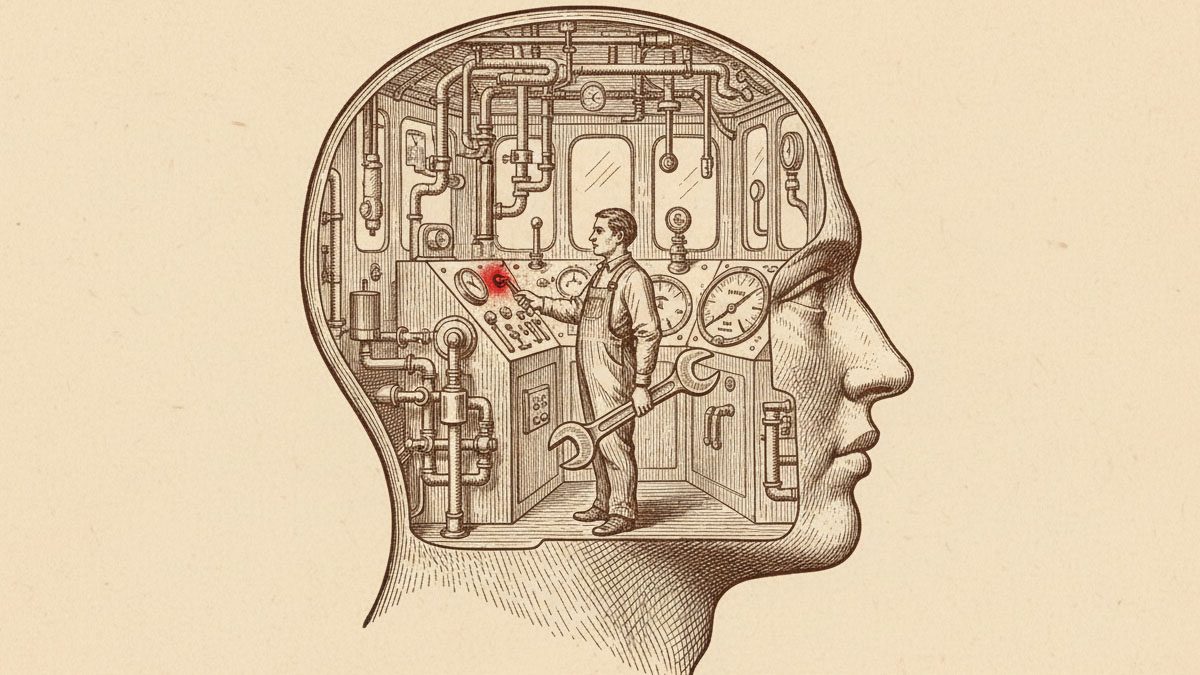
Here's the thing: you are not lazy. Your system is working exactly as designed. Procrastination is not a malfunction — it is a protective mechanism. Your brain is deliberately cutting off the energy supply to any action it judges as meaningless, dangerous, or impossible.

In this article, we'll break down the mechanics of resistance, learn to tell the difference between laziness and burnout, and discover how to negotiate with your brain — without going to war with it.

Why Procrastination Happens:
Your Brain’s Threat Response, Not Laziness

Engraving of a coachman struggling with unruly horses — a metaphor for the conflict between logic and emotion in procrastination

From an engineering perspective, procrastination is a conflict between two parts of your mind:

  1. The Prefrontal Cortex (Logic):
    'I need to finish this project — it's good for my career.'
  2. The Limbic System (Emotions and Instincts):
    'This action will bring pain, boredom, or danger. Cutting off the fuel supply.'

The limbic system wins every time — because it runs your survival responses. If it decides that an action is a bad deal (energy spent outweighs expected reward), it pulls the emergency brake. What you call laziness is simply a circuit breaker doing its job.

The core economic and biological principle that explains procrastination.

Why do you reach for social media (a cheap dopamine hit) instead of working on your project (a bigger, future reward)?

It's a cognitive bias called Hyperbolic Discounting.

  • Your brain values a reward available right now up to 100 times more than the same reward available next month.
  • For the limbic system — the ancient, primal brain — 'submitting a report next week' is an abstraction. But 'watching a meme' is real dopamine, delivered instantly.

The takeaway:
You're not lazy — you're biologically optimised. Your brain is choosing the guaranteed reward. To beat this, you need to make the reward for working feel closer (treat yourself to something small the moment you write the first line).

Procrastination Types Quiz:
Identify Your Personal Pattern

Table: 'Types of Procrastinators'

Type
🗣️ Inner Monologue
🔧 Engineering Fix

The Perfectionist

'If it can't be perfect, it's not worth doing.'

Create a deliberate 'rough and ready' draft — give yourself explicit permission to make mistakes.

The Dreamer

'This is too boring — I want to do something that truly matters.'

Gamify it: turn the boring task into a personal quest.

The Anxious Type

'What if I can't handle it?'

Decompose it: break the elephant into bite-sized micro-steps.

The Rebel

'I refuse to do this just because I "should".'

Find your 'I want' hidden inside the 'I should' (see Battery Desires vs. Vampire Desires).

3 Root Causes of Procrastination:
Fear, Perfectionism, and Hyperbolic Discounting

In our approach, we don't fight laziness head-on. We look for the reason the circuit breaker tripped in the first place. There are only three.

1. Vampire Goals
(A Conflict of Desires)

Engraving of a merchant rejecting an unfavourable deal on a scale — a metaphor for the brain refusing to spend energy on meaningless tasks

You're trying to do something you don't actually want ('I should'), while ignoring what you genuinely desire. We call these «Vampire Goals». (Read more about how they drain your life in the guide How to Find Your Purpose and Motivation.)

  • How it works:
    Your brain constantly calculates ROI (return on investment). When you force yourself through dull, soul-crushing work for some vague notion of 'duty', your brain sees the numbers clearly: energy is being spent, joy is nowhere in sight. So it blocks the action to conserve resources.
  • The tell-tale sign:
    The task fills you with a heavy, sinking feeling of dread.

2. Fear
(Perfectionism)

Engraving of an artist afraid to touch a blank canvas — a metaphor for perfectionism and the fear of making mistakes

You're afraid of failing, doing a poor job, or being judged.

  • How it works:
    To the primal brain, making a mistake equals death (being cast out of the tribe). The safest way to avoid failure is to do nothing at all. In this case, procrastination is a shield. This is often rooted in Impostor Syndrome and the belief that 'if it can't be perfect, there's no point trying.'
  • The tell-tale sign:
    You find yourself spinning your wheels before an important, 'make-or-break' task — endlessly preparing and waiting for the perfect conditions.

3. Running on Empty
(Burnout)

You simply have no energy left.

  • How it works:
    The battery is flat. The system has switched to emergency power-saving mode. Any activity at all feels like a threat to survival.
  • The tell-tale sign:
    You can't even motivate yourself to do things you normally enjoy — hobbies, leisure, fun. This is the critical marker. If even pleasant activities feel like too much effort, this is no longer laziness. It's exhaustion. Run a full self-assessment in the article Laziness or Burnout? How to Read the Signal Your Body Is Sending.

Dr Piers Steel developed an equation that models your motivation.

M = (E × V) / (I × D)

  • M (Motivation).
  • E (Expectation of success): Do you believe you can actually pull it off?
  • V (Value): Do you genuinely care about the task?
  • I (Impulsiveness): How easily do you get distracted?
  • D (Delay): How far away is the deadline?

How to hack the equation: If the task feels dull (low V), shrink the Delay (D) — set an artificial deadline: 'I'll have a rough draft done in 20 minutes.'

How to Stop Procrastinating:
Work With Your Brain Using Tiny Agreements

Engraving of towering gates with a small open side door — a metaphor for the small-steps method to bypass the brain's resistance

When you try to bulldoze your way through procrastination with sheer willpower, you're fighting your own biology. That's a fast track to burnout and anxiety.

Use the engineering approach instead.

Step 1. Interview Your Laziness

Instead of criticising yourself, ask your laziness directly: 'What are you protecting me from?'

  • From boredom? (Then gamify the task — or delegate it.)
  • From fear? (Then lower the stakes and give yourself permission to do it 'badly'.)
  • From exhaustion? (Then go and get some rest.)

Step 2. The 'Micro-Deal' Method

Your brain is terrified of big tasks ('Write my dissertation'). But it isn't afraid of small ones.

Make a deal with yourself:
'I'm not going to write the dissertation. I'm just going to open the file and type the title. If I want to close it straight away — I can.'

This bypasses the brain's threat-detection system. More often than not, it's enough to get you into the flow — appetite comes with eating.

Step 3. Making Rest Official

If you've identified exhaustion as the root cause, stop pretending to work. Sitting on social media while feeling guilty is not rest — it's draining your battery even further.

Give yourself official permission to do nothing. Lie down for 20 minutes without your phone. This will restore you far more effectively than three hours of procrastination.

The Carleton University Paradox

Practice: 'Self-Forgiveness'

Research by Professor Timothy Pychyl revealed a striking finding:

  • Students who forgave themselves for procrastinating before their first exam procrastinated significantly less before the second.
  • Those who criticised themselves drove their brains deeper into stress — and procrastinated even more.

The technique:
Tell yourself: 'OK, I got sucked into my phone. That's fine — my brain was tired. It happens. Now let's get back on track.' Drop the guilt like dead weight.

Research consistently shows that self-criticism makes procrastination worse, not better.

Technique:
The Swiss Cheese Method

If a task feels enormous and overwhelming (like a whole wheel of cheese), don't try to eat it in one go.

Start poking holes in it — small, random, easy sub-tasks.

  • Not 'write the dissertation', but 'find one image for the presentation'.
  • Not 'renovate the flat', but 'pick a colour for the skirting boards'.

Once there are enough holes, the task stops looking like a solid, impenetrable block — and starts to feel manageable.

  • 'Impulsiveness (I) is amplified by Information Overload. Put your phone out of reach to change the equation.'
  • 'Trying to overcome procrastination through willpower alone is futile — see the article Why Willpower Doesn't Work.'
  • 'If the micro-steps method isn't helping, you may not be dealing with procrastination at all — it could be Burnout — take the self-check to find out.'

What to Do When You’re Procrastinating Right Now:
A 5-Minute Reset

Stop treating laziness as the enemy. Laziness is a warning light on your dashboard. It's telling you that you're heading in the wrong direction — or that you've simply run out of fuel. Once you learn to listen to it, you'll never have to force yourself again.

In the premium Lesson "Why Laziness Is Your Most Honest Advisor" we explore:

  • How to transform laziness from a brake into a compass.
  • The 'Interview with Laziness' practice: a step-by-step script for a dialogue with your subconscious.
  • How to tell the difference between 'healthy laziness' (protection from poor decisions) and pathological apathy.

Stop fighting yourself. Start working with yourself.