Toxic Positivity:
Why Positive Thinking Can Increase Anxiety

Author: Alex Guru | Reading time: 7 minutes

Engraving of a man gilding a broken carriage — a metaphor for masking real problems with positive thinking.

The internet is flooded with advice: 'Smile at the world and it will smile back', 'Thoughts become things — focus on the good', 'Repeat affirmations in front of the mirror every morning'.
But when you're dealing with real problems — debt, divorce, illness, or chronic exhaustion — this kind of advice doesn't bring relief. It brings a quiet, simmering irritation.

You try to paste on a smile while everything inside you is boiling. You repeat 'I am calm' while your heart is pounding through your chest. And somewhere deep down, you know: this is a lie.

Sceptics call it 'wearing rose-tinted glasses'. Psychologists call it toxic positivity. From a systems perspective, it's like spray-painting over a rusted car body without cleaning off the grime and corrosion first. The paint will peel within hours — and the metal will keep rotting underneath.

In this article, we'll break down the real harm of positive thinking, explain the mechanics of self-deception, and show you why clear, honest thinking outperforms thousands of affirmations every time.

Why Affirmations Fail When You Feel Stuck, Stressed, or Burned Out

Engraving of a man hanging a picture in a burning room — a metaphor for the futility of affirmations during acute stress.

Imagine your mind is a room. If that room is on fire — with rage, fear, or panic — hanging beautiful landscape paintings on the walls (positive thoughts) is pointless. The fire will burn the paintings along with everything else.

Why don't affirmations work?

Because a fragile mental construct ('I am wealthy and happy') is going up against a powerful, biochemically charged emotion (fear of poverty).
In any battle between 'Thought vs Emotion', emotion wins every time — it's older, deeper, and far more energetically potent.

When you try to 'think positively' on top of unresolved negativity, you create inner conflict.

  1. Your subconscious screams: 'We're terrified!'
  2. Your conscious mind lies: 'Everything is wonderful!'
  3. The result: Cognitive dissonance and a breakdown in self-trust. You start to feel like a fraud in your own life.

Scientific evidence that affirmations can actually make things worse — the 'backfire effect'.

Do affirmations actually work?

Psychologist Joanne Wood at the University of Waterloo ran an experiment asking people with low self-esteem to repeat the phrase: 'I am a lovable and worthy person.'

Result:
Those participants felt worse than those who said nothing at all.

Why it backfires:
The brain compares the statement ('I am wealthy') against reality (mounting debt). It detects a lie and triggers cognitive dissonance. To resolve the contradiction, the subconscious starts firing back with counter-arguments ('You're lying — you're a failure'), amplifying the negativity rather than reducing it.

Conclusion:
Affirmations only work for people who are already doing well. For those who are struggling, they cause harm.

Reality Check:
Are You Practicing Optimism or Escaping Your Problems?

The alternative to toxic positivity isn't pessimism or complaining — it's clarity.

Comparison: 'Toxic Positivity vs Rational Optimism'

Category
🦄 Toxic Positivity (Illusion)
⚙️ Rational Optimism (Engineering)

Response to a problem

Denial ('Everything happens for a reason', 'There's no problem here').

Acknowledgement ('We have a problem. Let's assess the damage').

Emotions

'No room for sadness — good vibes only.'

'All emotions are data. Anger and fear have something to tell us.'

Action

Visualising success.

Planning concrete steps + accounting for risk.

Outcome

Collapse when reality hits.

Antifragility — the ability to handle adversity and grow from it.

The Real Problem With Toxic Positivity:
Emotional Avoidance and Denial

Engraving of a pressure gauge covered with a smiley face sticker — a metaphor for ignoring warning signals.

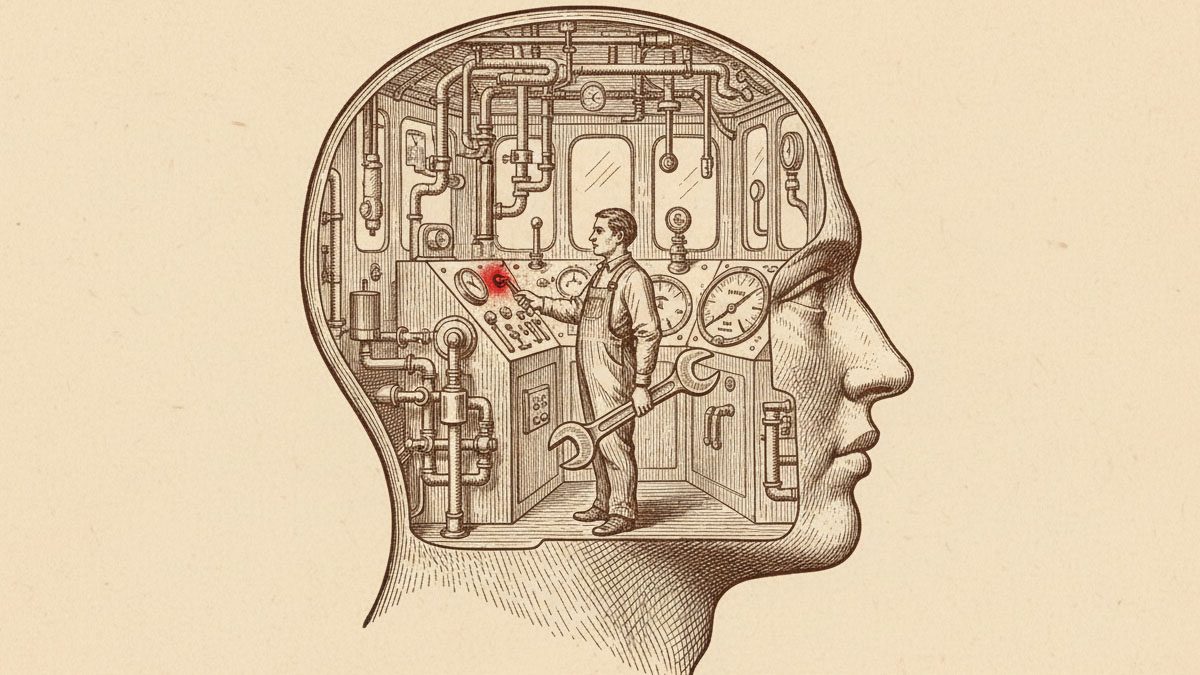
In the 'Mind Workshop' methodology, we draw a clear line between two very different things:

  • Elimination:
    Actually changing your internal state — genuinely switching off the negativity.
  • Suppression:
    Masking the negativity beneath a surface layer of forced calm.

Popular 'positive thinking', in its most widespread form, is suppression in disguise. Think of it as the 'covered warning light' effect. Your dashboard is flashing a Check Engine light (anxiety). You slap a smiley-face sticker over it. The warning disappears from view — but the engine keeps deteriorating. (To understand why suppressing emotions is genuinely harmful to your health — and how it differs from real resolution — read our dedicated article.)

What Happens When You Suppress Emotions:
Anxiety, Stress, and Self-Doubt

Engraving of a smiling mask cracking apart — a metaphor for emotional breakdown from forcing a positive facade.

When you push negativity inward while smiling through gritted teeth, you build enormous internal pressure.

  1. Energy drain:
    Maintaining the mask of a 'positive person' costs more energy than the actual work — or the actual problem-solving.
  2. Psychosomatic effects:
    Suppressed anger turns into digestive issues; suppressed fear manifests as chronic tension in the neck and shoulders. The body always sends the bill eventually. For a full breakdown of these connections, see our article Psychosomatic Illness: The Emotions Behind Physical Symptoms.
  3. Breakdown:
    Sooner or later, the pressure valve blows. You'll explode over something trivial — and potentially destroy the very relationships you were trying to protect with all that 'positivity'.

Clear Thinking Skills:
How to Process Emotions and Solve Problems

Engraving of an inspector examining cracks with a lantern — a metaphor for critical thinking and honest acknowledgement of problems.

You don't need to be 'positive'. You need to be clear-headed and effective.
Instead of self-deception, we offer a practical, step-by-step approach.

1. Acknowledge the facts (Critical thinking)

Stop lying to yourself. If you're struggling — admit it.

  • Unhelpful: 'I have no problems. Everything is a lesson from the Universe. I'm happy.'
  • Honest: 'I feel angry. I'm irritated. That's a fact. My system is overloaded.'
    Honest acknowledgement releases the charge and brings you back to solid ground.

2. Don't just 'think differently' — take action (Resolution)

Don't try to talk an emotion away with pretty thoughts. Work with it directly and technically.
Use an Elimination technique (shifting attention to an Anchor) to physically lower cortisol levels. We walk through a simple version of this in our article The 'Fire Extinguisher' Technique: How to Calm Down Quickly. Don't try to cover anger with forced joy — replace it.
Put the fire out first. Then hang the paintings.

3. Positive action — not positive thinking

Genuine positivity is built through action, not words.
Once you've calmed down (resolved the negativity), ask yourself: 'What is one concrete thing I can do right now to improve my situation?' Then do it. Real results build real confidence — not the manufactured kind.

This is one of the most powerful real-world stories from the worlds of business and survival — and it perfectly illustrates a clear-eyed, practical approach.

Admiral James Stockdale spent eight years as a prisoner of war in Vietnam. When asked who didn't survive, his answer was blunt: 'The optimists.'

  • The optimists would say: 'We'll be home by Christmas.' Christmas would come and go, they would still be in the camp — and they would die of a broken heart.
  • Stockdale survived because he lived by a different formula: 'Never lose faith that you will prevail in the end — AND at the same time, confront the brutal facts of your current reality.'

The key insight: Hope without a plan is not optimism. It's a slow-acting poison.

  • 'Forcing yourself to think positively creates an internal conflict that triggers endless Mental Rumination — a loop of arguing with yourself that never resolves.'
  • 'Instead of judging an emotion as "bad" (negative), activate your inner Observer and simply note that the emotion is there.'
  • 'Beneath a lot of positive thinking lies a Hidden Belief — something like: "If I ever feel sad, no one will love me."'

Quick Start:
5 Steps to Stop Forcing Positivity Today

Stop trying to be 'good' and 'spiritually evolved' at the expense of your mental health. Ignoring reality doesn't lead to happiness — it leads to anxiety and burnout.

In the premium Lesson 'Dismantling Harmful Myths: 'Just Be Positive' and 'Simply Accept Everything'' we cover in depth:

  • Why both extremes — toxic positivity and passive suffering — are equally destructive.
  • What 'Active Acceptance' actually means, and how it differs from self-deception.
  • How to maintain mental clarity without putting on rose-tinted glasses.

Become a realist who knows how to manage their inner state.