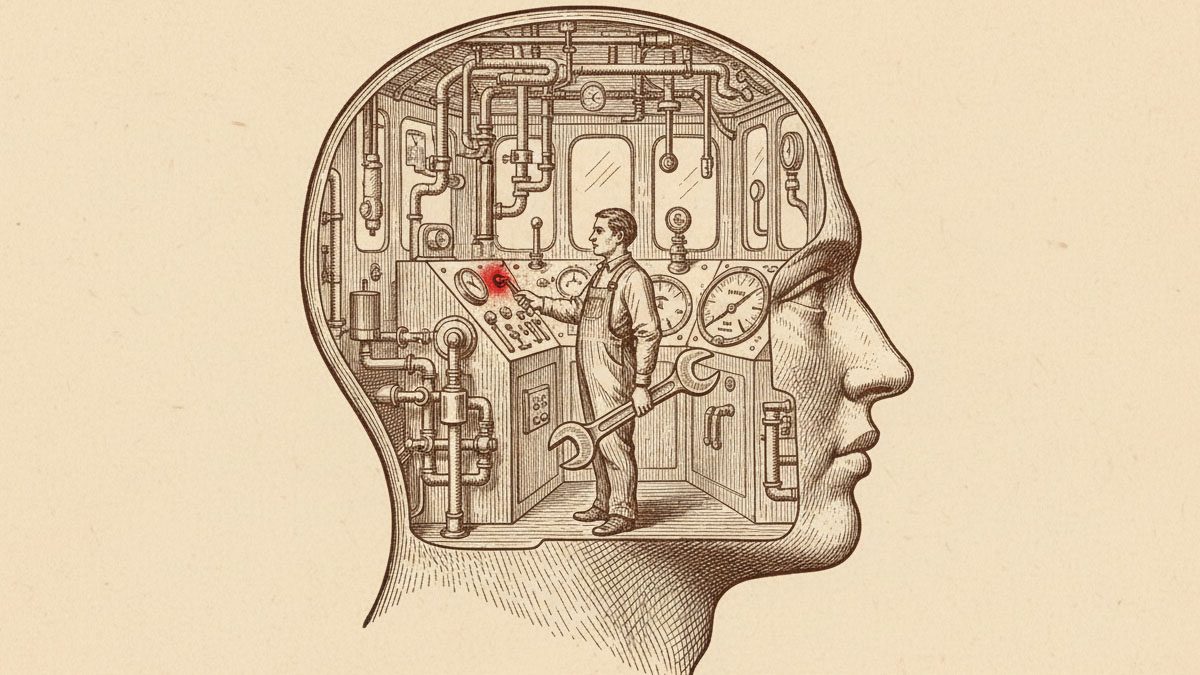
Therapy vs Life Coaching vs Self-Help:
Choose What You Need

Author: Alex Guru | Reading time: 8 minutes

Engraving of a broken-down car with a therapist and life coach offering advice — metaphor for choosing the right method when feeling stuck in life

You feel like you've hit a wall. Your career has lost its spark, your relationships feel stagnant, and getting out of bed in the morning takes everything you've got. You know something has to change. You go online — and are instantly overwhelmed: gestalt therapists, life coaches, success mentors, mindfulness courses.

Decision paralysis sets in. Do you need a life coach to push you toward your goals? Or a therapist to work through old wounds? Or maybe just pick up a self-help book?

As someone who approaches human potential like an engineer approaches a complex system, I'd like to cut through the marketing noise and look at this practically. Your life is a sophisticated system — and before you hire a specialist (or decide to go it alone), you need to run a proper diagnostic: find out exactly where the breakdown occurred.

In this article, we'll explore the real difference between a therapist and a life coach, why both approaches can fall short, and what a third path — the 'Engineering Approach' to self-mastery — actually offers. You'll discover that this isn't just a catchy label: it's rooted in biohacking and cognitive science. Consider this your honest, no-hype guide to the personal development market. The key insight: 'You don't need a coach to flog a dead motivation. You need an engineer to fix the engine.'

Therapist, Coach, or Self-Help:
Which Option Is Worth Paying For

This table could save you a significant amount of time — and money.

Comparison Table: Therapist vs Life Coach vs Self-Coaching

Your Situation
🚑 Therapist
🚀 Life Coach

⚙️ The Engineering Approach (Self-Coaching)

Energy Level

Critically low — can barely get out of bed.

Good — you have energy, but no clear direction.

Near zero — just enough to get through the day.

Core Problem

Trauma, grief, panic attacks.

'I want to 10x my income' or 'I want to scale up.'

Chaos, chronic stress, no structure or system.

Time Focus

The past ('My mother never really loved me').

The future ('Where will I be in five years?').

The present ('How do I stop feeling anxious right now?').

Outcome

Healing.

Achievement.

Emotional and mental self-regulation.

The Broken-Car Metaphor:
How to Know What Kind of Help You Need

Imagine you are a car. You want to get from point A — your current dissatisfaction — to point B: a fulfilling, happy life. But the car won't move. It's sitting on the side of the road with smoke pouring from the bonnet.

So you call in the specialists.

1. The Therapist arrives. 

They settle into the back seat, pull out a notebook, and begin: 'Tell me — how was this car built at the factory? Has it been in any accidents? Why does it

2. The Life Coach arrives. 

They jump into the passenger seat, unfold a map, and say with infectious energy: 'Look — point B is right there! Let's plot the route! Hit the accelerator! You've got this!' Their eyes are fixed on the road ahead.

Both approaches are entirely logical. But here's the catch: your tyres are flat and the tank is empty.

Until you fix the mechanics (your current state) and refuel (restore your energy), digging through the past is pointless — and planning for the future is impossible.

The 3 Core Paths of Personal Growth (Therapy, Coaching, Self-Development)

Let's look at each approach honestly, without the sales pitch.

1. Psychology
(Working with the Past)

Engraving of an archivist studying ancient records — metaphor for psychology as the practice of working through the past

Traditional therapy works with your personal 'archive.'

Focus: 
Trauma, childhood patterns, and suppressed emotions from the past.

Core logic: 
'If we understand what caused the breakdown, the car will start moving again.'

Systemic limitation: 
Understanding the cause doesn't always generate the energy needed for change. You can spend years unpacking your childhood, become a leading expert on your own neuroses — and still find yourself stuck on the sofa. You may become more self-aware, but no happier.

Verdict: 
Invaluable for repairing serious damage, but insufficient on its own to move you forward.

2. Coaching
(Working with the Future)

Engraving of a jockey whipping an exhausted horse — metaphor for the dangers of coaching when you are already burnt out

Coaching works with your ambitions.

Focus: 
Goals, plans, motivation, and time management.

Core logic: 
'Set a compelling goal, and the energy will follow.'

Systemic limitation: 
Coaching only works when you already have reserves to draw on. If you're experiencing emotional burnout, apathy, or persistent background anxiety, pushing yourself to 'achieve more' is simply self-harm in disguise. It's like whipping an exhausted horse — it might run another mile, then collapse entirely.

Verdict: 
A powerful tool for those who are already well-resourced and simply need direction. Potentially harmful for anyone in crisis.

3. The Engineering Approach
(Working with the Present)

Engraving of a mechanic repairing an engine — metaphor for the engineering approach to managing your inner state

This is the methodology behind the 'Mind Workshop.' We don't revisit the past or daydream about the future. We work with the system's parameters right now.

Focus: 
Your State. Energy levels, quality of attention, and the presence of 'negative background noise'.

Core logic: 
'The past is memory (thoughts). The future is imagination (thoughts). Only your present state is real. Change your state — and both your perception of the past and your capacity to build the future will shift accordingly.'

Medicine treats illness. Engineering builds resilience.

There are two fundamental approaches in health science:

  • Pathogenesis (Psychotherapy):
    Studies the origins of disease. Focuses on 'why it broke down.' Goal: eliminate pain.
  • Salutogenesis (Engineering / Biohacking):
    Studies the origins of health. Focuses on 'how to make the system more robust.' Goal: build lasting resilience (antifragility).

Our work is grounded in salutogenesis. We're not concerned with why you burnt out. We're focused on how to rebuild your internal energy system so it can handle pressure — and thrive under it.

The “Savior” Mindset:
Why We Outsource Our Happiness and Power

The most common question from beginners is: 'How do I find the right mentor?' Behind this question often lies a very human, childlike impulse: 'Find me an adult who will take responsibility for my life.'

You want the therapist to 'fix' you and the coach to 'lead you to success.' That's a dead end.
No one can live your life for you.

Self-help or professional therapy? 

The engineer's answer:
Even when working with a specialist, 99% of the real work happens between sessions. Without self-regulation skills, no guru — however talented — can help you.

The urge to find a Guru or mentor is a classic expression of an external locus of control.

  • You believe your life is shaped by outside forces — doctors, managers, coaches.
  • The goal of the 'Mind Workshop' is to shift that locus inward (internal locus of control): 'I am the primary cause of what happens in my life.'
  • Research shows that people with an internal locus of control earn around 30% more on average — and tend to live longer.

The Real Fix:
Become the Creator and Designer of Your Life

Engraving of a ship's captain at the helm — a metaphor for taking responsibility for your own life.

The engineering approach invites you to stop being a passenger and start being the driver — and the mechanic.

What does this look like in practice?

  1. Fixing the leaks (Repair).
    Instead of searching for your 'life purpose' (the coaching approach), you first identify the cracks through which your energy is draining away — resentments, anxiety, and, of course, energy vampires in your environment and in your own head. You learn practical techniques (such as 'Flawless Elimination' from Course 1) to patch those holes for good.
  2. Refuelling (Building Energy).
    You learn to generate positive inner states — joy, curiosity, anticipation — right here, right now. You don't wait for life to get better before allowing yourself to feel good. You choose to feel good so that you have the energy to make life better.
  3. Setting your navigation (Strategy).
    Only once you have energy ('fuel') and have cleared away negativity ('the brakes') do you activate your Inner Compass (intuition). You begin to feel what you truly desire. And from there, moving towards your goals happens naturally — without force, without the relentless grind of 'hustle culture'.

The Tool:
An Energy Audit of Life's Key Areas

Exercise: 'The Balance Wheel 2.0' (Audit) — an engineering-style diagnostic tool.

Instead of asking 'How satisfied am I?' (subjective), ask 'What is my energy level here?' (objective).

  • Career: Does it give you energy or drain it?
  • Family: A source of strength or a black hole?
  • Body: A generator or a burden?

Fix the area with the biggest leak first. That's where you'll see the fastest improvement across your entire system.

The Foundation of Success:
Self-Efficacy

Psychologist Albert Bandura introduced the concept of Self-Efficacy — your belief in your own ability to handle a challenge.

It doesn't grow from affirmations. It grows only through Mastery Experiences — moments when you prove to yourself what you're capable of.

  • When you resolve your own anxiety in five minutes — without a therapist — your self-efficacy grows. You realise: 'I am in control of myself.'

How to Self-Coach:
Build a Lifelong Skill for Growth and Resilience

(learn more about our autonomous development system in the article Self-Coaching)

You need a therapist when you've broken your leg. You need a coach when you're training for the Olympics. But navigating everyday life — making decisions, handling stress, finding joy — that's a skill you need to own yourself.

At the 'Consciousness Workshop', we don't hand you a fish. We give you the rod, a map of the lake, and instructions for building the boat.

If you feel stuck, stop swinging between regrets about the past and anxiety about the future. Focus on the present. Design your life the way a lead engineer would — not a temporary worker.

  • 'Coaching during burnout is like tuning an engine that's already on fire. Put out the flames first — follow the guide in Emotional Burnout.'
  • 'A therapist can help you understand why you keep attracting energy vampires — but for the practical steps to set firm boundaries, see Where Your Energy Goes.'
  • 'The ultimate goal of self-coaching is not solving one problem — it's building a Solid Inner Core.'

Next Steps:
Take Control of Your Life Starting Today

Move on to Course 8: Your Life Strategy.

We won't be digging through childhood wounds or writing wish lists that never materialise. We'll be working on the architecture of your personality, building deep-rooted confidence, and creating a system that works for you for years to come.

P.S. If you don't even have the energy for strategy right now, start with repair. Run your leak diagnostic in Lesson 1.1.