Negative Emotional Background Meaning:
Hidden Chronic Stress Explained

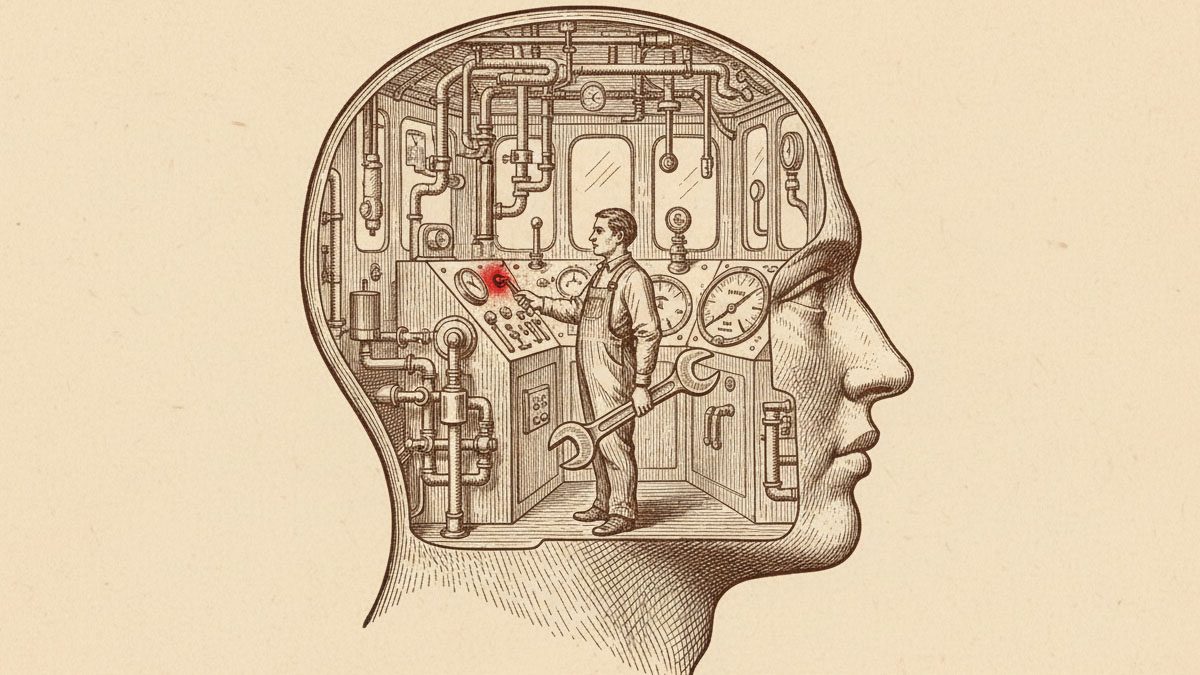
Engraving of a person looking at the world through a dirty glass pane — metaphor for negative emotional background distorting perception.

Negative emotional background is a persistent psychoemotional state — like a low-frequency hum or residue — formed from hundreds of accumulated, unprocessed micro-emotions (irritation, anxiety, boredom). Unlike acute pain or anger, this background state often goes unnoticed, feeling like a personal "new normal." Yet it constantly drains the nervous system, keeping it locked in a chronic energy-loss mode.

How Negative Emotional Background Builds Up (Allostatic Load Mechanism)

Two glass vessels side by side — one with clear water, one murky — metaphor for accumulating emotional residue over time.

To understand this phenomenon, imagine your mind as a glass of crystal-clear water.

Throughout the day, small irritations occur: traffic on the way to work, a cold glance from a colleague, an unsettling news headline. Each reaction is like a tiny pinch of dirt dropped into the glass. Individually, each one is barely noticeable. But if none of it is cleared away, by evening the water has turned cloudy.

The negative emotional background acts like a dirty lens filter on a camera:

  1. Accumulation:
    Emotional "residue" builds up and becomes denser.
  2. Distortion:
    You begin to see the world through this layer of "murk." Even joyful experiences — sunshine, rest, a delicious meal — feel dull and unsatisfying.
  3. Exhaustion:
    The body expends enormous energy on suppressing emotions (read separately about why this is harmful), leading to chronic fatigue and burnout with no obvious cause.

In medicine, what we call "Negative Emotional Background" is known as Allostatic Load.

  • Stress is a short-term spike (a cortisol surge) — your body's response to an immediate threat.
  • Allostatic load (Background) is the cumulative wear and tear caused by that spike never fully returning to baseline.

How it works:
Your system runs on permanent "Yellow Alert" — 24/7. Your adrenal glands don't flood your bloodstream with cortisol all at once (as in a panic attack) — they release it in a slow, steady drip. But over the course of a month, this creates a toxic buildup that damages hippocampal neurons (affecting memory) and suppresses immune function.

Do You Need Help or Will It Fade? Self-Assessment Guide

Table: "Negative Background vs. Low Mood vs. Depression"

Parameter
☁️ Low Mood (A Reaction)
🌫️ Negative Background (A System Malfunction)
🌑 Depression (A Clinical Condition)

Cause

A specific event (an argument, a setback).

Unclear. "Things seem fine, but something feels off."

Disrupted brain chemistry.

Duration

Hours or 1–2 days.

Months or years ("This is just how I always feel").

More than 2 weeks with no relief.

Response to joy

You can get distracted and laugh.

Joy feels muted and fades quickly.

Anhedonia (a physical inability to feel pleasure).

Sleep

Normal.

Not restorative (morning fatigue).

Early waking or insomnia.

Solution

Rest and time.

Deliberate mental hygiene practices.

Psychotherapy + medication.

Common Signs of Negative Emotional Background (Symptoms to Notice Early)

Engraving of a family dining beside a passing train — metaphor for habituation to chronic background stress.

If you have lived with this background state long enough, you may no longer notice it — much like people who live near a railway line stop hearing the trains. Yet the signs are hard to miss once you know what to look for:

The "Life Is Fine, But I Feel Nothing" Effect:

On the surface, everything looks okay — but inside there's a persistent sense of grayness, emptiness, or a weight you can't quite name.

Disproportionate Reactions:

You snap at something trivial — a dropped cup, a slow Wi-Fi connection — with a force that doesn't match the situation. This is the anger burst mechanism at work: your "emotional container" is already full to the brim, and even one more drop triggers an overflow.

Background Anxiety:

A constant, low-level sense that something bad is about to happen — even when you are objectively safe.

Quick Quiz:
How Emotionally Contaminated Are You Right Now?

Engraving of an overflowing bowl — metaphor for emotional breakdown caused by accumulated negative background.
How do you know this is a persistent background state — and not just ordinary tiredness? Check yourself against these 4 markers. If you recognize yourself in at least two of them, your psyche is running in emergency mode.

1. Your Reaction Is Out of Proportion to the Trigger (Overloaded Buffer)

Neutral things start to irritate you: your partner's breathing, the ping of a notification, a slow elevator.

  • How it works:
    Your "glass" is already full to the brim. Even the tiniest addition — a sound, a word — causes it to overflow (an outburst of irritation) completely out of proportion to what actually happened.

2. Mornings Without a Reset (Recovery Failure)

You open your eyes and immediately feel heaviness, anxiety, or apathy — before you've even remembered your problems or your to-do list.

  • How it works:
    The system failed to "reset" overnight. The residue of unprocessed emotions has become so dense that sleep no longer functions as a restorative mechanism.

3. "Anesthesia" of Joy (The Dirty Filter)

You notice that good news no longer moves you. A purchase, a delicious meal, a work success produce only the thought: "Sure, fine — so what?"

  • How it works:
    In order to suppress the negative background, the psyche "turns down" the sensitivity of all receptors. You stop feeling pain — but at the same time, you lose the ability to taste life.

4. Intolerance of Silence

Being still and quiet feels physically uncomfortable. You reach for your phone, turn on music, or put a show on in the background.

  • How it works:
    External noise serves to drown out the internal "hum" of the negative background. The moment outside stimulation disappears, you are left alone with your inner state — and it becomes unbearable.
  • "Negative Background is the primary reason people get stuck in Energy-Loss Mode."
  • "Accumulated background often breaks through as an Attack pattern (anger bursts)."
  • "Negative Background is the leading reason you wake up feeling drained — see the article Why Do I Wake Up Exhausted."
  • "Background is the fuel for an explosion. Learn how to keep it from igniting in the article Anger Bursts."
  • "When the background becomes a habit, it turns into a Muscular Armor, settling into the body as chronic physical pain."

How to Clear a Negative Emotional Background (Practical Recovery Steps)

Quick Method: "Airing Out"

Biohack: The "Ventilation" Technique (Micro-Habit) — a simple, beginner-friendly reset.

If you've realized the water in your glass has gone murky, don't try to "calm it down." Replace the water.

  • Physical release:
    A sharp exhale with the sound "Ha!" Shake out your hands.
  • Sensory reset:
    For 10 seconds, shift your attention to any external object (the texture of a table, the sound of the street outside).

This momentarily interrupts the mental "hum" and reduces allostatic load.

Fighting a negative background directly (trying to simply "cheer yourself up") is pointless — it's like stirring muddy water to make it clear.

To cleanse the mind, you need to stop adding new layers of "mud" to it. This calls for a systematic, engineering-style approach:

  1. Awareness:
    Learn to notice micro-negativity at the very moment it arises — while it's still just a spark.
  2. Elimination:
    Apply the technique of "Generating Joy" or "Flawless Elimination" to dissolve the emotion before it settles and takes hold.

This term is a core concept of Course 1: "Freedom from Suffering". A detailed breakdown of how mental contamination works — along with a self-assessment of your own background level — is available in the free Lesson: