How to Stop Jealousy in Relationships Without Controlling Anyone

Author: Alex Guru | Reading time: 8 minutes

Engraving of a man crushing a bird in his embrace — a metaphor for jealousy as destructive control in relationships.

Your phone vibrates. You catch a glimpse of a message on your partner's screen. Your heart skips a beat. Blood rushes to your face. In an instant, your mind starts spinning a full-blown drama: 'Who is that? Why did he smile? Where has she been for the past two hours?'

You call it love. You tell yourself: 'I get jealous because I care.'
But let's be honest. In that moment, you are not loving. In that moment, you want to possess, control, and punish.

The psychology of jealousy is straightforward: it's a cocktail of fear, wounded ego, and a craving for total control. It's not 'the spice of a relationship' — it's sulphuric acid quietly eating away at intimacy.

Many people spend years in therapy searching for answers on how to stop being jealous. Here, we take a different approach — a technical one. Jealousy is not a personality flaw. It's a **glitch** in your internal security system, one that can be fixed with a hard reset. This article is written through the lens of relationship neuroscience. You'll discover that jealousy is neither 'deep love' nor 'low self-esteem' — it is an evolutionary resource-protection mechanism that misfires in the modern world.

Othello Syndrome

Othello Syndrome (named and described by psychiatrists John Todd and Kenneth Dewhurst) is a psychopathological condition defined by delusional, pathological jealousy — an irrational and unshakeable conviction that a partner is being unfaithful, despite the complete absence of real evidence.

Jealousy Triggers:
The Hidden Need to Control Your Partner

Engraving of a spy watching a couple through a distorted lens — a metaphor for paranoia and a warped perception of reality.

You turn into a detective. You check likes, monitor when they were last 'online', and hunt for hidden meaning in every word.

This state of deep distrust of your partner is exhausting. You live trapped inside your own imagination — a place that generates constant Background Anxiety that never lets you breathe easy.

You believe that if you keep close enough watch, you can avoid being hurt.

Evolutionary biology explains why jealousy is so agonising. This isn't a metaphor — it's a literal activation of the brain's pain centres.

Why does jealousy cause physical pain?

Neuroscientists have found that during a jealousy episode, the Anterior Cingulate Cortex (ACC) lights up.

  • This is the very same region responsible for physical pain.
  • To your brain, 'He glanced at someone else' registers the same as 'I just touched a hot stove'.

The evolutionary logic:
For our ancestors, losing a partner meant death — no food, no protection. The brain delivers a sharp pain signal to force you to 'protect your resource' (known as Mate Retention Behaviour).

The takeaway:
Your jealousy is outdated survival software — completely ill-suited to life in the 21st century.

Jealousy vs Love:
Signs of Othello Syndrome and Obsessive Suspicion

People often mistake tyranny for love. The table below offers a clear-cut way to tell healthy concern apart from destructive jealousy.

Table: 'Normal vs Pathological Jealousy'

Parameter
❤️ Healthy Jealousy (A Signal)
☠️ Pathological Jealousy (A Glitch)

Trigger

A real event (flirting, infidelity).

A fantasy ('He was online for too long').

Goal

To protect the relationship.

To gain control and power.

Action

An honest conversation about feelings.

Surveillance, interrogations, checking their phone.

Outcome

The issue is resolved (or the relationship ends).

Anxiety grows with every check.

Underlying logic

'I trust you until I have real reason not to.'

'Prove to me you haven't done anything wrong.'

The Jealousy Loop:
How Your Brain Misreads Threat and Creates Drama

Engraving of sand slipping through a clenched fist — a metaphor for the futility of trying to control another person.

Control doesn't provide security. It only produces anxiety. The tighter you squeeze your fist, the more sand slips through your fingers.

The Root of the Problem:
Intolerance of Uncertainty (IU)

A jealous person cannot bear the absence of guarantees.

Jealousy is an attempt to secure a 100% certainty that simply does not exist.

  • You check their phone chasing the illusion of control.
  • But control works like a drug: you need a bigger dose each time.

The real challenge:
Learning to sit with the discomfort of not knowing — 'I don't know where they are right now, and I choose to be at peace with that'.

Jealousy Recovery Story:
How Nino Broke the Cycle of Distrust

Nino (33, photographer) came to the 'Workshop' on the verge of a breakdown. Jealousy was destroying her relationship. She would subject her partner to interrogations over liked photos, turning into someone she didn't recognise — and then burn with shame afterwards. Traditional therapy and unpacking childhood wounds gave her insight into the 'why', but offered no tool for the 'what do I do right now?' moments when the wave of emotion crashed over her like molten lava.

Diagnosis:

Pathological emotional dependency. The 'Attack' pattern. (To understand how the aggression mechanism works and why we lash out at those closest to us, read the article Anger Outbursts: Why You Snap at the People You Love).

Solution:

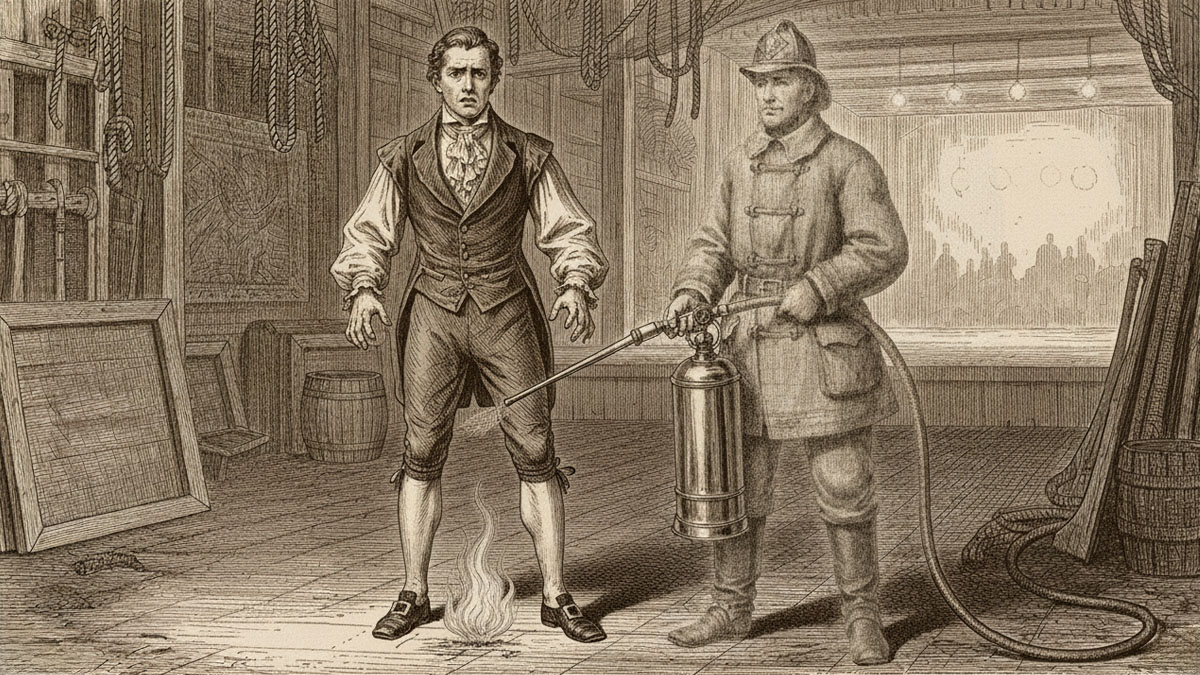
I didn't try to talk her into calming down. I handed her a fire extinguisher — the 'Storm' technique. Nino declared all-out war on her jealousy.

Result:

A week later she wrote: 'The emotion has become... boring. It's lost its dramatic power. What used to feel like an all-consuming demon has turned into an annoying fly that I've learned to swat away.'

The STORM Method:
A Step-by-Step Tool to Calm Jealousy Fast

If you're looking for a real way to stop being jealous of your partner, forget the advice to 'just trust them'. In the middle of a jealousy episode, that simply doesn't work. What you need is a targeted operation to clear your mind.

The 'Storm' Method (described in full in the Lesson) is a technique of intensive, repeated neutralisation of a negative emotion under controlled conditions. You don't run from the monster. You lock yourself in a room with it and systematically dismantle it.

Engraving of a blacksmith tempering a blade in fire and water — a metaphor for the 'Storm' technique of alternating provocation and release.

How the method works (in brief):

You set aside a block of time (15 minutes, for example), start a timer, and work in cycles:

  1. Provocation:
    Deliberately bring to mind the thought or image that causes pain ('He's smiling at someone right now').
  2. Neutralisation:
    In that same instant, forcefully apply the 'Generating Joy' technique, anchoring yourself to your most powerful positive feeling.
  3. Repeat:
    The moment you feel calm — summon the pain again. Then neutralise it again.

You repeat this cycle 10, 20, 30 times in a row.

It's an exhausting mental workout. But by the end of the session, something remarkable happens: the brain grows tired of being afraid. The neural circuit overloads and breaks. Jealousy stops feeling like a 'sacred fire' and becomes a dull, mechanical hum that you can simply switch off.

This is pathological jealousy treatment through response exhaustion.

The 'Storm' Method is grounded in the clinical protocol of ERP therapy (Exposure and Response Prevention — the gold-standard treatment for OCD).

  • The principle:
    If someone has a fear of germs, a therapist has them touch something dirty — and then prevents them from washing their hands.
  • Applied to jealousy:
    You deliberately summon the feared thought ('My partner is cheating on me') and then resist the urge to check their phone or call them.

The Habituation Effect:
Within about 20 minutes, the brain registers: 'I had that terrifying thought — and nothing happened.' The anxiety fades on its own. The fear circuit breaks down.

Why Reassurance Talks Fail:
The Psychology of Rumination and Doubt

Engraving of a scholar trying to reason with a wild beast — a metaphor for the powerlessness of logic against the instinct of jealousy.

You can spend hours talking with your partner, asking for reassurance and promises of fidelity. But it won't work. Because jealousy doesn't live in the rational mind — it lives in the limbic system (the brain's ancient emotional core).

Logic is no match for the biochemistry of fear.

The only way to win is to rewrite the reflex itself. You need to learn to stop the Emotional Rollercoaster before it sweeps you off the edge.

Reality Check Exercise:
Fact-Checking Thoughts to Reduce Jealousy

The Algorithm:
'Fact or Interpretation?'

When jealousy hits, take a sheet of paper and divide it into two columns:

  1. Camera (Facts):
    What would a video camera actually record? (Example: 'He came home 15 minutes late').
  2. Movie (Interpretation):
    What story is my mind making up? (Example: 'He was with someone else, he doesn't love me, I'll end up alone').

The moment you see the gap between '15 minutes late' and 'full-blown affair', the emotional charge begins to dissolve.

  • "Checking your partner's phone is a serious violation of Personal Boundaries. It's not love or care — it's an invasion of privacy."
  • "Jealousy triggers an endless cycle of Rumination — replaying worst-case scenarios on a loop. Use the techniques in this article to break the cycle."
  • "At the root of jealousy often lies Impostor Syndrome in relationships: 'I don't deserve this love — sooner or later they'll leave me.'"

Start Here Today:
5 Small Steps to Stop Jealousy Spirals

Stop being a guard dog chained to your own fears. A relationship should be a space for joy — not surveillance.

If you're ready to stop tormenting yourself and your partner, what you need isn't a friend's advice — you need a serious tool for rewiring these patterns at their source.

Master an advanced technique for working with obsessive emotional states in the premium Lesson: The Art of 'Emotional Swings': How to Work with Jealousy and Other Intense Emotions.

Take back control. The jealousy will fade — and if the love is real, it will remain.