Emotional Suppression Explained:
Why “Just Calm Down” Backfires

Author: Alex Guru

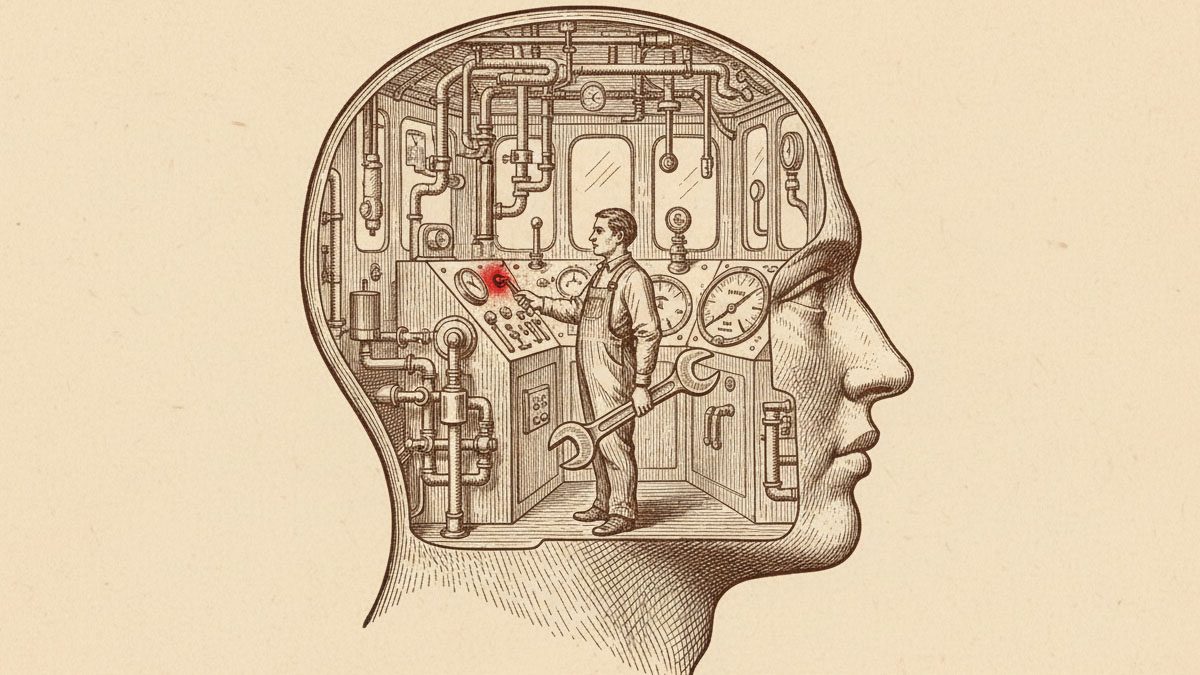
Engraving of a volcanic man and a calm adviser. A metaphor for the futility of 'just calm down' advice when someone is overcome with anger.

You're boiling over. People are getting on your nerves — on public transport, at the office, at the dinner table. Even slow Wi-Fi feels like a personal attack. You're right on the edge. And then someone, with the best of intentions, says: 'What's wrong with you? Just calm down.'

In that moment, the last thing you want to do is calm down. That phrase alone is enough to send even the most composed person into a fresh wave of fury. You find yourself asking: 'Why am I so on edge all the time?' — and then you start blaming yourself for losing control.

But here's the truth: your reaction is completely normal. The advice to 'calm down' doesn't work because it's fundamentally flawed. In this article, we'll break down the mechanics of irritability and explain why trying to 'just calm down' is actually the fastest route to a breakdown. Think of this as a diagnostic deep-dive into irritability: the neurological foundations and a practical framework for understanding what's really going on.

Emotional Suppression Definition:
What It Means Psychologically

Telling someone to 'just calm down' is a call for emotional suppression. It demands an immediate halt to the outward signs of anger or anxiety — while completely ignoring the underlying cause. In terms of how the mind works, it's the equivalent of trying to force released energy back into a sealed container. This is classic emotional suppression — which, unlike genuine resolution, doesn't lead to calm. It simply 'preserves' the negativity, where it quietly festers and takes a toll on your health.

Why Emotional Suppression Backfires:
The Pressure Cooker Effect

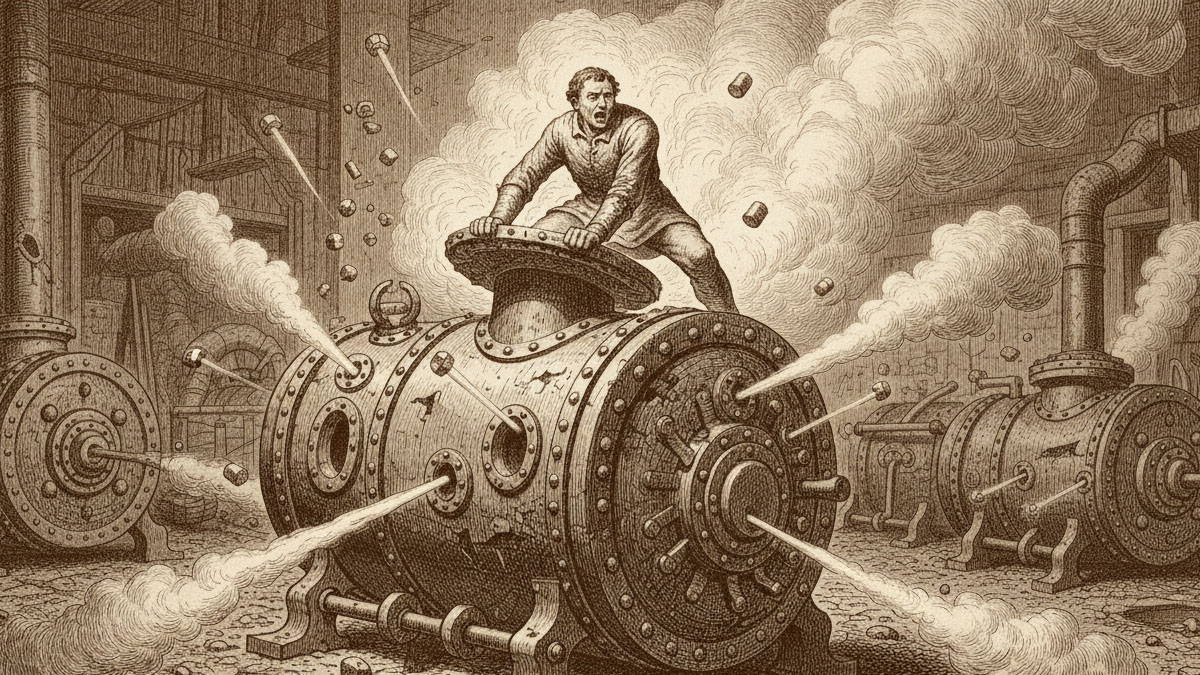
Engraving of a man tightening bolts on a boiling pressure cooker. A metaphor for emotional suppression and rising internal pressure.

When you feel like everything is driving you mad, it means your internal 'pressure cooker' is already at full boil. The steam pressure — what we call emotional background noise — has reached a critical level. It's this accumulated tension that makes it impossible to truly relax.

When someone tells you to 'calm down,' they're essentially asking you to bolt the lid onto that boiling pressure cooker.
Here's what happens, mechanically speaking:

  1. Pressure keeps building. The heat under the cooker hasn't been turned off. Steam continues to build, but now it has nowhere to escape.
  2. Energy is drained. You're burning enormous amounts of mental energy just trying to keep that lid on — to maintain your composure and 'keep it together'.
  3. An explosion becomes inevitable. Sooner or later, the bolts will blow. And when they do, you'll snap over something completely trivial — a dropped fork, an innocent question.

The phrase 'calm down' triggers rage precisely because your mind recognises it as a form of violation. You're being asked to pretend there's no problem — while you're falling apart inside.

Why does 'just calm down' act like a red rag to a bull and trigger an even stronger reaction? It's not oversensitivity — it's a protective psychological response.

In psychology, this is known as invalidation.

When your brain is in a state of anxiety or anger, it's sending out a genuine distress signal. The phrase 'calm down' tells your subconscious: 'Your alarm system is broken. There's nothing wrong. You're overreacting.'

Your brain's response:
Rather than settling down, the amygdala — your brain's threat-detection centre — identifies the person giving this advice as an adversary who is denying your reality. It doubles down on adrenaline production to 'fight back' and assert that your emotional response is valid.

The takeaway:
You're not losing your mind. You're reacting to having your reality dismissed.

Am I Emotionally Suppressing? Signs You’re On Edge (Checklist)

Sometimes 'everything irritates me' isn't about psychology at all — it's about your body (blood sugar, hormones, sensory overload). Use this table to rule out physical causes first.

Table: 'Is It Physical or Psychological?'

Cause
🌡️ Physical Trigger (Body)
🧠 Psychological Trigger (Mind)

Trigger

Everything is irritating: sounds, light, touch.

Specific people or topics are irritating (work, a partner).

Time of day

Gets worse in the evening or before meals.

Depends on thoughts and events.

Sensations

Trembling, weakness, headache, brain fog.

Jaw tension, a strong urge to prove your point.

Solution

Food, sleep, quiet (sensory offloading).

The 'Resolution' technique, setting boundaries.

Everyday Irritability Examples:
What Emotional Suppression Looks Like

Scenario 1:
The Accumulation Effect

Engraving of an avalanche triggered by a small stone. A metaphor for a disproportionate reaction caused by accumulated irritation.

You've spent all day tolerating your boss's behaviour — biting your tongue, 'keeping it professional' (which really means suppressing). That evening, your partner asks: 'What do you want for dinner?' You explode.

Why:
It's not the question that set you off. It's the fact that your emotional tank is already full — overflowing with suppressed anger at your boss. In this moment, being told to 'not get so worked up' is nothing short of insulting.

Scenario 2:
Background Irritability

Engraving of a person with exposed nerves in a crowd. A metaphor for background irritability and hypersensitivity.

You're on the tube, and everyone around you is getting on your nerves — the way they stand, the way they breathe, the way they stare at their phones.

Why:
This is a symptom of long-term suppression. Your mind is overloaded with 'bottled up' negativity. Every external stimulus is just one more drop in an already overflowing glass.

The Hidden Cause:
Sensory Overload

In the modern world, many people find themselves overwhelmed by noise — a constant form of background irritation.

Your brain is a processor with a finite capacity.

  • If you've been bombarded all day — office noise, phone notifications, harsh lighting, uncomfortable clothing — your processor is overheating.
  • By the evening, when someone chews loudly next to you, you snap. Not because of the chewing. But because that was the final bit of input that crashed the whole system.

Solution:
15 minutes in a dark, quiet room (sensory rest).

How to Stop Emotional Suppression:
Release Tension Without Exploding

Engraving of a steam valve being opened. A metaphor for safely releasing built-up emotional pressure.

If you feel yourself coming to a boil, the worst thing you can do is try to 'calm down' — which really means forcing the emotion back down.

  1. Acknowledge your right to feel angry.
    Tell yourself: 'I'm not losing it. I'm overloaded. My anger is a signal that I've hit my limit.'
  2. Don't suppress it.
    If you can't express it out loud (social situations prevent that), at least stop berating yourself for feeling it.
  3. Look for release, not containment.
    What you need isn't to 'pull yourself together' — it's to find a way to let off steam or address the source of the pressure.

Genuine calm doesn't come through willpower. It comes through the technique of emotional resolution — which turns off the heat under the pressure cooker, rather than forcing the lid down tighter.

The HALT Quick Self-Diagnosis Protocol

The HALT Protocol (Essential Tool) — this is the gold standard for managing irritability: a simple, concrete self-help framework.

Before searching for deep psychological wounds, check the basics. In 80% of cases, what feels like uncontrollable rage can be resolved not with meditation, but with a sandwich.

The acronym HALT comes from addiction therapy:

  • H (Hungry) — Are you hungry?
    Blood glucose drops → Cortisol spikes → Aggression (known as the 'hanger' effect).
  • A (Angry) — Are you angry?
    Is there a specific source of anger you suppressed an hour ago and haven't dealt with?
  • L (Lonely) — Are you lonely?
    Feelings of isolation and being misunderstood heighten anxiety significantly.
  • T (Tired) — Are you tired?
    Did you actually sleep last night?

The golden rule:
If H or T applies — do not make decisions or have difficult conversations. Refuel first.

Social Navigation:
How to Respond to 'Just Calm Down'

What do you say when someone tells you to calm down?

Most people don't know how to respond — so they swallow the frustration in silence.

You don't need to be rude, but you do need to protect your boundaries. Try this script:

  • 'I know you're trying to help. But when you say "calm down", I feel like I'm not being heard. What I need right now isn't to calm down — I need five minutes of quiet / I need someone to listen.'

This shifts the conversation from conflict to genuine connection.

  • 'Trying to follow the advice to "calm down" is precisely what triggers the mechanism of emotional suppression — turning you into a pressure cooker.'
  • 'If the state of "everything irritates me" is ignored, it will inevitably escalate into uncontrollable anger outbursts.'
  • 'Irritability is the primary symptom of high levels of emotional noise in the system.'

Quick Reset:
What to Do When Everything Irritates You Right Now

Why 'keeping it together' is genuinely dangerous — and what conditions it leads to — is something we explore in depth in our course.

In the free Lesson 'Why 'Keeping It Together' Is Dangerous: The Suppression Trap' you will discover:

  • The difference between appearing calm on the outside and experiencing true inner peace.
  • Two patterns of suppression: the 'Explosion' (emotional breakdown) and the 'Slow Burn' (illness and apathy).
  • How to stop being a ticking time bomb.