Ego Dissolution Explained:
Disidentification for Clearer Thinking

Author: Alex Guru | Reading time: 6 minutes

Engraving of a snake shedding its old skin — a metaphor for personal evolution and transcending the old Ego.

Personal evolution is not simply an endless process of improving your character, accumulating skills, or boosting productivity. At its deepest level, it is a radical shift in the very centre of gravity of your consciousness. It is a process of disidentification — moving away from seeing yourself as a collection of habits, fears, and social masks (the 'Ego'), and recognising yourself as the pure Awareness within which all of these phenomena arise.

Most people spend their entire lives redecorating their prison cell. (To discover where you currently stand on this journey, explore our Personal Development Map: From Beginner to Master). True spiritual transformation begins the moment you find the key and walk out the door.

In this article, we examine Self-Transcendence through an engineer's lens — a scientific perspective, free of religious texts and abstract philosophy. You will discover that the 'Ego' is not your soul — it is a neural network that can be reprogrammed.

🛡 Safety First:
Who Should Avoid Disidentification and Emptiness Practices

The techniques described here — disidentification, stopping inner dialogue, working with emptiness — are powerful tools that directly affect the psyche.

Contraindications:
Clinical depression, mental health conditions (schizophrenia, bipolar disorder, psychosis), and use of strong psychiatric medication. If you are under psychiatric care, only practise these techniques with your doctor's approval.

If you experience intense anxiety or psychological destabilisation, stop the practice immediately and ground yourself.

Vertical Development is a term from adult developmental psychology, most notably associated with Susanne Cook-Greuter, and is a highly respected framework among leadership professionals.

  • Horizontal development:
    Adding new apps to an old phone — acquiring new skills, knowledge, and languages. The operating system stays the same.
  • Vertical development (Evolution):
    Upgrading the Operating System itself. You begin to perceive the world with greater complexity, depth, and clarity. Your 'processor' becomes significantly more powerful.

Why Ego Death Feels Terrifying:
The Neuroscience of Identity and Fear

Engraving of a prisoner decorating his cell instead of escaping — a metaphor for endless self-improvement within the confines of personality.

In the early stages of growth, we make a fundamental attribution error. We equate ourselves with our inner processes.

  • We say: 'I am angry,' instead of 'I am experiencing anger.' This creates a trap that leads either to emotional outbursts or to Emotional Suppression, because we end up fighting 'ourselves' rather than the reaction.
  • We say: 'I am lazy,' instead of 'I have a habit of putting things off.'

This sets a trap. When you try to eliminate a negative quality — say, laziness — your subconscious perceives it as an attack on your very identity. It feels as though you are trying to 'amputate' a part of yourself. This is precisely why change feels so hard: your survival instinct kicks in to protect what it believes is you.

What esoteric traditions dramatically call 'ego death' is, in the language of consciousness engineering, simply the correction of a fundamental identification error. You don't need to die. You simply need to understand who you truly are.

The key scientific argument — 'The Illusion of Self' (Neuroscience)

Does the 'I' physically exist? No.

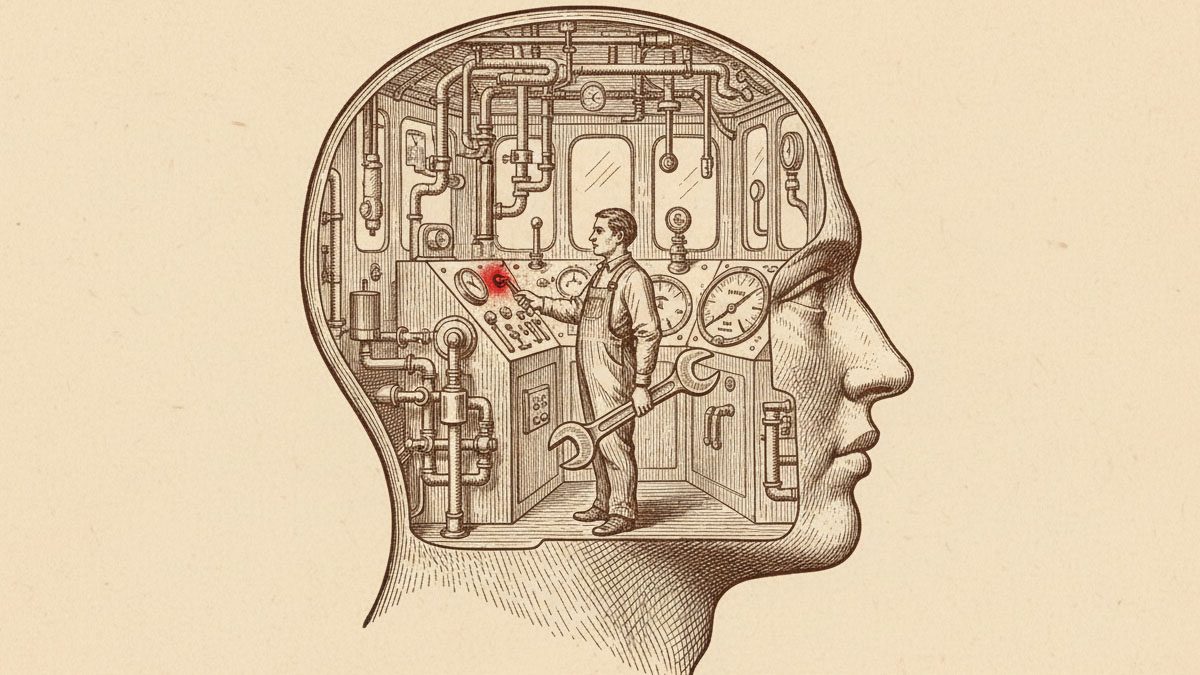
Neurophilosopher Thomas Metzinger demonstrated: there is no 'little person' (homunculus) sitting inside the brain, watching the film of your life.

The Ego is simply a PSM (Phenomenal Self-Model) — a virtual model of the self that the brain constructs moment to moment in order to navigate the world.

Conclusion:
'Ego death' is not the death of the organism. It is simply a temporary suspension of the user interface (UI) in order to access the command line — the core of the system.

Self-Inquiry Test:
Who’s Running Your Mind—You or Your Conditioning

This table will help you distinguish between Personality and Essence.

Table: 'Personality vs Essence'

Parameter
🎭 Personality (Ego / Mask)
👁️ Essence (The Observer)

Nature

A collection of habits, past wounds, and social roles.

Pure, open awareness.

Response to pain

'I am hurting, I am suffering.'

'I am registering a pain signal in the system.'

Relationship with time

Lives in the past (memory) and the future (fear).

Exists only in the 'Here and Now.'

Attitude towards change

Resistance (defending the status quo).

Acceptance (observing the flow).

Metaphor

An actor who has forgotten they are playing a role.

A member of the audience.

How Disidentification Works:
Step-by-Step Mechanics of Detaching from Thoughts

Engraving of a person struggling to remove a mask fused to their face — a metaphor for the painful process of disidentifying from the Ego.

Moving beyond the mind and personality is a technical skill — the ability to shift your mode of perception.

Imagine your Personality (Ego) is a set of clothes. They may be old, worn out, or simply uncomfortable.

  • In the mode of identification, you believe the clothes are glued to your skin. Trying to remove them causes pain.
  • In the mode of disidentification, you realise: 'I am not the clothes. I am the one wearing them.'

Once this split occurs, fear and resistance dissolve. You move from the position of the 'Patient' — who is afraid of the pain — to the position of the 'Surgeon' (or the Observer), who calmly and precisely removes what is no longer needed.

The evolution of consciousness is a journey from complete fusion with your inner programmes to genuine freedom from them.

The term 'Metacognition' is the scientific name for mindfulness.

The ability to think about your own thinking is called Metacognition.

  • Animals have consciousness (they feel pain).
  • Humans have self-awareness (they know they are feeling pain).
  • Evolution is the development of the capacity to 'step outside yourself' and observe your own patterns from a distance. The higher your level of metacognition, the less you are on autopilot.

Everyday Results:
Real Examples of Emotional Freedom and Mental Clarity

Situation 1: A Sudden Surge of Anger

Engraving of an observer on a mountain watching a storm cloud — a metaphor for witnessing emotions without being swept away by them.

The average person:
Completely consumed by the emotion. They are the anger. They lash out and then regret it. They cannot stop themselves, because 'you can't stop yourself.'

The practitioner:
Notices the emotion arising. They see the anger as an external object — like a dark storm cloud passing through the sky of their awareness. They say: 'A anger response has arisen in my system.' And they calmly let it pass without being pulled in.

Situation 2: Fear of Change

The average person:
'I'm a coward, I'll never manage it.' The Personality resists anything new, defending its comfort zone. This is the law of homeostasis — the inner force that blocks any meaningful change (for a deeper look at the mechanics of resistance, read our article The Art of Small Steps and the Power of Inertia).

The practitioner:
Recognises the fearful thought as a worn-out old record playing on repeat. They don't argue with it — they simply observe: 'This is just my mind's old habit of fearing the new. This is not me.'

Try the “Not Me” Method:
A Simple Practice to Stop Over-Identifying

Engraving of a person cutting strings connecting them to their shadow — a metaphor for the 'Not Me' practice and breaking free from Ego identification.

You don't need to retreat to a monastery to move beyond the Ego. You need to master a single mental tool: 'The Great Release.'

The method is simple, but requires practice:

  1. Catch it:
    Notice any thought, emotion, or desire as it arises.
  2. Name it:
    Give it a label — for example, 'anxiety' or 'a thought about failure.'
  3. Apply the formula:
    Silently say to yourself: 'This is here, but this is not Me.'

This phrase severs the neural link that had you fused with the problem. In an instant, you reclaim your position as the one in charge.

The Algorithm: The Subtraction Method (Neti-Neti)

Practice: 'Not This' (Neti-Neti) — a classical Advaita method reimagined for the modern world.

An ancient technique for finding your core by stripping away everything that isn't you:

  1. Body: 'I can observe my hand. Therefore, I am not my hand (the Observer is not the Object).'
  2. Emotions: 'I can observe my anger. Therefore, I am not my anger.'
  3. Thoughts: 'I hear a voice in my head. Therefore, I am not that voice. I am the one who hears it.'

Everything you can observe is not You. You are what remains when everything observable has been set aside.

  • 'The instrument of evolution is the position of the Impartial Observer — which becomes your permanent home.'
  • 'The personality is 90% made up of Consciousness Viruses and borrowed beliefs. Evolution is the process of cleaning up the code.'
  • 'What remains after the Ego dissolves, we call the Inner Core — your true nature.'

Mastery Level:
How to Stabilize Awareness and Sustain Clear Thinking

The question 'Who am I?' stops being philosophical and becomes deeply practical the moment you begin applying the technology of disidentification in real time. It is the fastest path to personal transformation available to us.

Would you like to learn how to instantly separate yourself from your fears, habits, and limitations — and discover absolute inner freedom?

The full protocol for this powerful technique, including important safety nuances, is available in the premium Lesson: The Great Liberation: Mastering the Art of Self-Transcendence.

Stop patching the 'costume'. Remember who's wearing it.