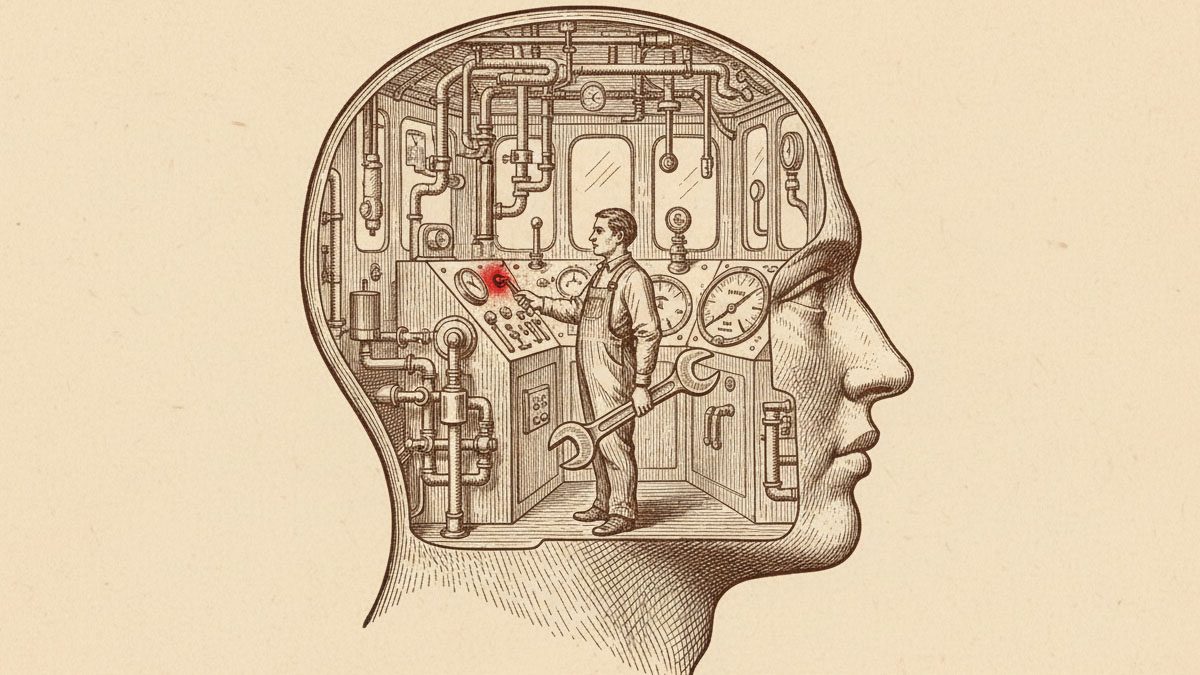
Mind Virus Meaning Explained:
How Social Programming Hijacks Thoughts

Engraving of a mechanical parasite infiltrating a human brain — metaphor for a mind virus and mental infection.

Mind viruses (mental viruses) are destructive informational programs — beliefs, dogmas, and stereotypes — implanted into the psyche from the outside, which a person mistakenly takes for their own thoughts. They run in the background like malware on a computer: consuming mental resources, distorting perception of reality, and driving irrational behavior while blocking the capacity for independent thinking.

How Mind Viruses Spread:
Memetics, Social Programming, and Mental “Malware”

Engraving of a false messenger slipping past city gates — metaphor for foreign ideas bypassing critical thinking.

From an engineering perspective, your brain is a powerful biocomputer (for a full breakdown of its architecture, see the article The User Manual for Your Mind That Nobody Gave You).

1. Infection:

Viruses enter through channels of social programming — upbringing, media, social environment — at moments when your "firewall" (critical thinking) is switched off: during childhood, or in states of intense emotion such as fear or misplaced trust in authority. (To understand exactly how authority figures and society bypass your defenses, read Why Arguing Is Pointless: The Mechanics of Mental Infection.)

2. Installation:

A foreign idea — "money is evil," "you need to fit in" — gets written into the root directory of your subconscious and granted administrator privileges.

3. Execution:

From that point on, you no longer think through a situation — you automatically run the script. You act not in your own best interest, but exactly as the virus prescribes.

4. Self-Defense:

The virus protects itself. Any logical attempt to challenge the dogma triggers aggression or irrational rejection in the host — a system error.

Signs of a Mind Virus:
Common Examples, Triggers, and Red Flags

Engraving of a man with a parrot's head — metaphor for mindlessly repeating other people's dogmas.

You can distinguish your own thoughts from a viral program by running a simple "stress test" and observing how your system responds:

Aggressive defense:

If someone questions your belief and you feel instant anger instead of curiosity — that's a virus.

No reasoning available:

You're 100% certain about something, but can't explain why — falling back on phrases like "that's just how it is," "everyone does it," or "it's obvious."

Internal conflict:

You want one thing (say, success) but do the opposite (self-sabotage your work). This is a clash between your authentic programming and the viral code.

Chronic mental drain:

Viral programs run constantly in the background, consuming working memory and producing persistent fatigue.

Self-Check:
Is This an Authentic Thought or an Implanted Belief

"How do I know whether I'm actually thinking this — or whether it's a virus?"

Table: "Yours vs. Theirs"

Parameter
💡 Your Own Thought (Healthy code)
🦠 Mental Virus (Malicious code)

Origin

You arrived at this through personal experience and analysis of real evidence.

"That's just how things are done," "Everybody knows," "That's what I was told growing up."

Emotion when challenged

Curiosity («Why do you disagree? Tell me more»).

Aggression or fear («Shut up! You don't know what you're talking about!»).

Flexibility

Updates when new evidence appears.

Rigid dogma. Evidence is ignored («So much the worse for the facts»).

Purpose of the program

Your own benefit, growth, and fulfillment.

The system's benefit — conform, consume, comply, sacrifice yourself for an idea.

The scientific foundation (Memetics):

In 1976, biologist Richard Dawkins introduced the concept of the "Meme". A meme is a unit of cultural information that behaves exactly like a biological virus.

  • Its goal is not to make you happy.
    Its goal is to replicate itself.

The virus "You must get married before 25" or "Big money is dangerous" lives in your head for one reason only: so you pass it on to your children. For the host — you — it typically delivers nothing but anxiety and suffering.

  • «When a virus runs in a system long enough, it hardens and becomes a Blind Belief — part of your very skeleton».
  • «The virus defends itself through Attack mode: you lash out at someone because they are threatening your program».
  • «Maintaining your viruses — keeping up appearances, fearing judgment — is the ultimate Black Hole of Attention».

How to Remove Mind Viruses:
Practical Steps to Reclaim Independent Thinking

Engraving of a scientist examining a beetle under glass — metaphor for quarantining and analyzing a viral belief.

Treating mental viruses requires switching into "Manual Override" mode — the Pilot's mindset:

  1. Quarantine:
    When you catch an automatic reaction, pause. Don't let the script execute.
  2. Code analysis:
    Ask yourself: "Where did I get this from? Is this a fact, or something I simply came to believe?" Engage your critical thinking.
  3. Removal:
    Use pattern-interruption techniques — such as the "Mirror" Technique for dismantling dogmas — to neutralize the virus.

Neutralization Technique:
The "5 Whys"

Practice: The "5 Whys" Method — a legendary debugging technique developed by the founder of Toyota, and one of the most practical tools for tracing a belief back to its source.

How do you crack a virus? Dig down to its source code.

When you catch yourself holding an irrational belief (for example, "I feel guilty for resting"), ask yourself "Why?" five times in a row.

  • Why do I feel guilty? — Because I should be useful.
  • Why do I have to be useful? — So that people value me.
  • Why do I need people to value me? — Because if I'm not useful, I'll be rejected.
  • Why would I be rejected? — Because that's what my mother always said.
  • Why did she say that?Because she herself was infected with the virus of anxiety.

By the 5th level, you usually see that the emperor has no clothes. The virus loses its power the moment you see where it came from.

This term is a core concept of Course 3: "Clear Thinking". You can run a full diagnostic of your own mental system — and discover how these programs are shaping your life — in the free lesson: