Blind Beliefs Meaning:
Unconscious Assumptions Shaping Your Reality

Anatomical engraving of a human figure with an iron framework instead of a skeleton. Metaphor of blind beliefs as the load-bearing structure of personality.

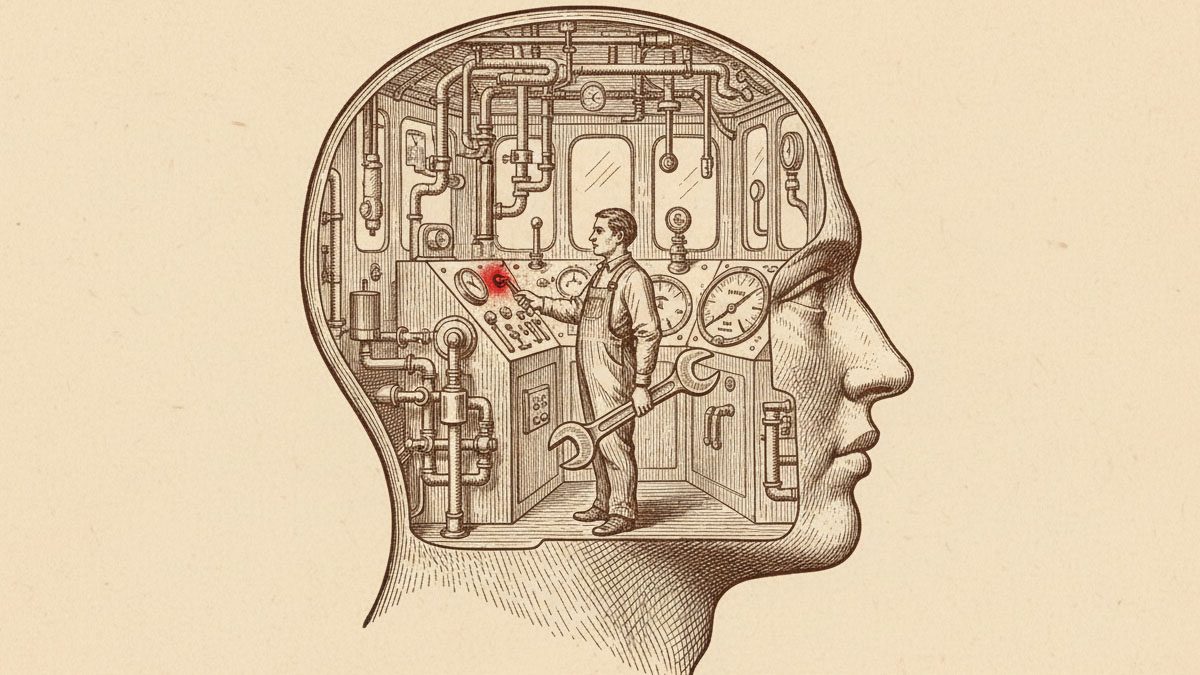
Blind beliefs are fundamental, unconscious psycho-emotional assumptions that form the load-bearing structure — the "skeleton" — of your personality. These are not simply thoughts you think; they are core rules for perceiving reality that you accepted on faith (most often in childhood) without critical examination. They operate like a hidden operating system (read more about the architecture of the mind in The Owner's Manual for Your Mind That Nobody Gave Us): you never see the source code, yet it entirely determines how you react, feel, and act in any situation.

Blind beliefs are a critical error in the code (in our own mind). Understanding how they work is the key to understanding why we suffer at all.

How Blind Beliefs Form and Run Your Mind (Psychology Explained)

Engraving of a person wearing distorting glasses. Metaphor of beliefs as filters that shape our perception of reality.

To understand the nature of this phenomenon, think of it like human anatomy.
Your behavior, emotions, and current thoughts are the "soft tissue" and "skin" — they can change. But the shape of your body is determined by a rigid internal framework: the skeleton.

1. Formation:

In childhood, you "downloaded" other people's rules into yourself — "the world is dangerous," "money is the root of all evil," "love must be earned." These rules hardened and became the load-bearing structures of your psyche.

2. Filtering:

A blind belief works like a lens. You don't see reality — you see only what passes through the belief's filter. If you're running the program "I am unlovable," you will consistently ignore signs of affection and notice only indifference.

3. Automatic reaction:

When reality collides with one of your rigid beliefs — for example, you make a mistake while running the program "Making mistakes is unacceptable" — the system triggers an instant alarm signal: shame, anger, or panic.

It is precisely these limiting beliefs that explain why intelligent people repeat the same self-destructive patterns for years on end. A crooked skeleton won't let you walk straight.

Fact vs Limiting Belief:
How Cognitive Distortions Mimic Truth

Most people don't realize what a "belief" actually is. They think: "But it's true!" This table shows how a mental virus disguises itself as objective reality.

Table: "The Virus vs. Reality"

🦠 Blind Belief (The Virus)
🔎 Objective Fact (The Event)
📉 Consequence of the Virus

"Nobody loves me"

A colleague didn't say hello this morning

You feel hurt and deeply alone

"There's never enough money"

You spent your entire paycheck before the month ended

Instead of finding new income streams, you cut back on food

"Making mistakes is dangerous"

You made a typo in a report

Panic attack, fear of being fired

"I must be perfect"

You are simply human

Chronic anxiety and burnout

Key insight:

This is an interpretation you chose to believe.

This is a neutral event.

Top 5 Core Limiting Beliefs (Mental “Viruses”) That Control Behavior

The most common limiting beliefs that hold people back.

Most people operate on one of these five core scripts:

  1. "I am not good enough" (Impostor syndrome, perfectionism).
  2. "The world is dangerous / There's never enough" (Scarcity mindset, anxiety about the future, workaholism).
  3. "Love must be earned" (People-pleasing, losing yourself in relationships).
  4. "Don't stand out" (Fear of success, self-sabotage in career).
  5. "I have to do it alone / No one can be trusted" (Isolation, inability to delegate).

Recognize your "favorite" script? That's not your character. It's simply a program that was installed.

How to Identify Blind Beliefs:
Common Signs, Triggers, and Patterns

Engraving of a bird beating against a glass dome. Metaphor of limiting beliefs and the invisible glass ceiling blocking personal growth.

The core problem with blind beliefs is that they are invisible to the person who holds them. They feel like "common sense" or "objective truth." Yet they can be detected through indirect signs:

Chronic emotional patterns:

You consistently feel guilt, anxiety, or resentment in similar types of situations.

The glass ceiling:

You keep hitting an invisible barrier in your finances or relationships, no matter how hard you try. For example, Impostor Syndrome is a classic result of the belief "I am not good enough" — it silently blocks all growth.

Absolute language:

You frequently use words like "always," "never," "everyone," and "nobody" (for example: "No one can be trusted," "All men are the same...").

Rigidity:

Any attempt to challenge your view triggers defensiveness or anger — not curiosity.

  • "To 'pollinate' an action, you first need to create a powerful Joy Anchor (see the guide), which you will then transfer onto the activity."
  • "The 'Pollination' technique is the best way to replenish your Energy Budget without stepping away from your work."
  • "Use your shower as a trigger for Emotional Polishing as well."

How to Change Limiting Beliefs:
Practical Steps to Rewire Your Mind

Engraving of a surgeon extracting a stone from a patient's head. Metaphor for removing a harmful limiting belief through conscious inner work.

Working with blind beliefs is difficult because the mind protects them as the very foundation of its sense of safety. You can't simply "think differently." What's required is a kind of "surgical intervention":

1. Diagnosis:

Locate the "bone" — the specific wording of the belief — using the "X-ray" method: tracing it through your negative emotions.

2. Destabilization:

Subject the belief to doubt using logic and evidence. For this, we use the "Mirror" Technique (the antivirus for your mind), which creates a short circuit in the old program.

3. Replacement:

Form and internalize a new Core Belief — a belief grounded in reality rather than fear.

Quick Self-Test:
Catching the Virus Through Your Own Words

Exercise: The "Linguistic Trap" — a concrete diagnostic tool that works through the language you use.

Blind beliefs are always absolute. They tolerate no exceptions.

The next time you notice a strong emotional reaction, pay close attention to the thoughts running through your mind. If you catch any of these marker words, you've found the trap:

  • EVERYONE / ALL («All men are...», «Every boss I've had...»)
  • ALWAYS / NEVER («This always happens to me», «You never listen»)
  • NO ONE / NOBODY («Nobody needs this anyway»)
  • MUST / SHOULD («I should know everything»)

What to do:

Simply replace the absolute marker word.

  • Instead of "I never have any money" say "Right now, I don't have the money for this."
  • Instead of "Everyone ignores me" say "This particular person is busy right now."

The magic is this: the moment the absolute disappears, so does the feeling of hopelessness.

This process is at the heart of Course 4: "The Art of Discernment". You can run a full diagnostic of your own "inner skeleton" and identify exactly which beliefs are keeping you stuck in a free introductory lesson: