How to Find Your Life Purpose and Stay Motivated Naturally

Author: Alex Guru | Reading time: 14 minutes

Engraving of a person unearthing a gold nugget from rubble — a metaphor for discovering your true life purpose from within.

You wake up in the morning with no answer to the question: "Why?" Why go to this job? Why go through the motions? You sense you're living someone else's life — but you have no idea what your own life would even look like.

You search "how to find your purpose" and get served tarot cards, astrology, or advice along the lines of "just do what you love." But the problem is, you don't know what you love. Or maybe you do — but you're afraid it won't pay the bills.

You try to change your life through sheer discipline: setting goals, writing lists, pushing yourself. But within a week, the motivation evaporates and apathy sets in.

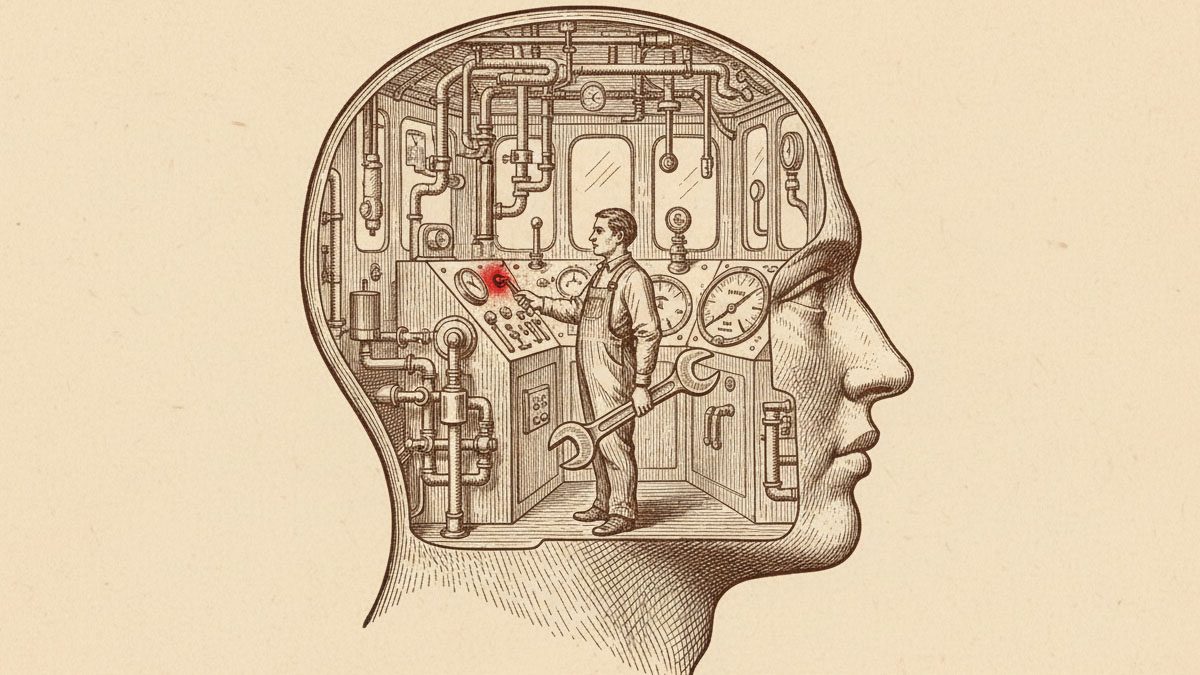
From an engineering-of-the-mind perspective, "purpose" is not some mystical point on a map waiting to be discovered. It's the way your engine is meant to run. Right now, your engine is stalling — because you're filling it with the wrong fuel.

In this guide, we'll break down the mechanics of human motivation. We'll let go of the myth of the "great calling" and learn how to find energy in everyday things — so you can build a life you actually want to live.

Why You Feel Lost in Life:
Escaping the “Good Child” Programming

Engraving of a conveyor belt turning children into puppets — a metaphor for social conditioning and the loss of individuality.

Many people asking "where do I even begin with self-development" make the same mistake: they look for new knowledge outside themselves. But the problem isn't a lack of information — it's a broken connection with who you really are.

Think back to childhood.
You knew exactly what you wanted: splashing in puddles, drawing on the walls, watching ants for hours. Your desires were vivid, and they gave you instant energy.

Then the social conditioning machine switched on.

You were told:
"Stop wasting time", "You can't always get what you want", "You need to be useful."

What happened, in mechanical terms:

Your internal navigation system was overwritten.

  1. Your true desires ('I want') were labelled as 'silly', 'selfish', or 'shameful'.
  2. Other people's programmes ('I should') (what we call Mind Viruses) were installed as if they were your own goals. (For more on how this mental code works, read The User Manual for Your Mind That Nobody Gave You).

You grew up. Now you're a successful (or not-so-successful) adult who has mastered doing what you 'should' — but has completely lost the muscle for what you 'want'.

You don't know what you truly want because the signal from your inner compass has been drowned out by the noise of other people's expectations. Your apathy isn't laziness. It's a system in revolt — forced to run on software it was never designed for.

Why 'I quit everything and became an artist' success stories can actually mislead you.

When you read about great achievers, you only ever hear from those who took the leap and won.

You never hear from the 99% who took the same leap and fell.

  • The logical flaw: We assume success comes from one bold move — a single leap of faith.
  • The reality: Success is the result of hundreds of small experiments and tested hypotheses.
  • The engineering approach: Don't quit your job overnight. Launch a 'parallel process' — test your passion as a hypothesis for one hour a day.

Self-Assessment Chart:
What’s Really Motivating You Right Now

Willpower alone won't take you very far.

Table: 'Discipline vs Motivation'

Factor
👮‍♂️ Discipline (I Should)
🔋 Motivation (I Want)

Fuel source

Glucose in the prefrontal cortex (a limited resource).

Dopamine from the striatum (a renewable resource).

How it feels

Tension, an internal battle.

Flow, excitement, ease.

How long it lasts

A sprint (enough for 2–3 weeks).

A marathon (years).

Best used for

Getting started and maintaining routine (brushing your teeth, filing a report).

Choosing your direction and creative work.

Motivation Psychology:
Energy “Boosters” vs Everyday “Drains”

Engraving contrasting a person weighed down by a burden and a person radiating light — a metaphor for draining desires versus energising ones.

To understand how to achieve your goals without burning out, you need to grasp the two types of fuel your mind runs on.

In Course 2, 'The Path to Yourself', we introduce a fundamental distinction between two types of desire.

Type 1. Draining Desires ('I Should')

These are goals driven by fear, obligation, or pride.

  • Example:
    'I need to get promoted so my dad will be proud of me', 'I need to lose weight so people will love me'.
  • How it works:
    Just thinking about the task brings a sense of heaviness, dread, or resistance.
  • The result:
    You spend your energy not on doing the thing, but on overcoming the resistance to it. This is one of the leading causes of chronic exhaustion. (Find out where else your energy is leaking in the article Emotional Burnout and Energy Leaks). Even when you reach the goal, you don't feel joy — you feel empty. This is negative motivation.

Type 2. Energising Desires ('I Want')

These are your genuine, authentic drives.

  • Example:
    'I want to learn guitar because I love the sound', 'I want to write this code because it genuinely interests me'.
  • How it works:
    Just thinking about the task creates anticipation. Your eyes light up. Energy arrives before you've even started.
  • The result:
    The process fills you up rather than draining you. This is positive motivation.

The key insight:

You cannot find your purpose while your life is crowded with 'Drains'. You simply don't have the free energy to hear the quiet voice of your 'Batteries'.

The Dopamine of Anticipation

How does your brain recognise something as 'your thing'?

Through a dopamine signal called the Reward Prediction Error (RPE).

  • You try something new (say, painting).
  • If the experience is better than expected → Dopamine surge → The habit is reinforced.
  • If it's worse than expected or simply boring → Dopamine drops → Aversion forms.
  • Takeaway: Look for activities that give you a 'wow' feeling in the process itself — not just when you imagine the end result.

Finding Your Inner Voice:
A Simple Self-Discovery Method That Works

If you don't know what you want, don't try to think your way to an answer. Logic is a tool for analysis — not a generator of desire. Instead, use the 'Archaeology' method.

Step 1. The Anticipation Test

Stop dividing tasks into 'useful' and 'useless'. Start dividing them into things that give you energy and things that take it away.

  • Exercise:
    Look at your to-do list. Close your eyes and imagine doing each item. What do you feel? A heaviness in your chest (a Drain) — or a quiet flutter of excitement (a Battery)?
  • Your goal:
    Begin ruthlessly eliminating or delegating your 'Drains'.

Step 2. Hunting for 'Ghosts'

If you're deep in apathy (we explored the difference between apathy and ordinary laziness in the article Laziness or Burnout?), big desires won't show up. So look for micro-desires instead.

  • 'I want to drink tea from that nice mug I never use.'
  • 'I want to walk instead of taking the bus.'
    Act on these desires immediately. This trains your brain to recognise: 'My desires matter. I hear them. I act on them.' It rebuilds the neural connection between 'I want' and 'I do'.

Step 3. Reawakening

Think back to what you loved as a child, before you became a 'serious adult'. Lego? Drawing? Climbing trees?
Try doing it again now — not for any outcome, but purely for the experience. Often it's there, in those forgotten childhood passions, that the key to your true purpose is hiding.

Goal Setting Without Burnout:
A Sustainable System for Follow-Through

Everyday motivation cannot run on willpower alone. Willpower is an emergency reserve — it runs out fast. Lasting, long-term momentum is only possible when fuelled by Genuine Desires (your Batteries).

The 'Common Sense' Principle

Engraving of a captain and navigator on a ship — a metaphor for the collaboration between emotion and reason.

Once you've found your 'I want' (say, 'I want to travel'), your Rational Mind often panics: 'We don't have the money! It's not safe!'
Instead of suppressing the desire, bring your Heart and Mind into partnership.

  • Heart (the Captain):
    Sets the destination. ('I want to travel.')
  • Mind (the Navigator):
    Doesn't argue with the goal — it charts the safest course to get there. ('Understood, Captain. To make that happen, we need to save X amount and learn the language. Let's make a plan.')

The 'Plan B' Technique

Fear of failure is paralysing. Often hiding behind it is Impostor Syndrome, whispering: 'You'll never pull it off — sooner or later they'll find you out.' To start moving forward, **mentally rehearse the worst-case scenario** before you begin.

  • 'What's the absolute worst that could happen if I try and fail?'
  • Accept that scenario. Build a contingency plan for if things go wrong.
    When the fear of 'failure as death' dissolves, an enormous amount of energy is freed up for actually living.

Do You Need a Calling? How Purpose Grows Through Small Experiments

Engraving of a seed growing into a powerful vortex — a metaphor for cultivating your life's purpose from a small spark of interest.

We often imagine that our life's purpose will arrive like a bolt of lightning — a sudden flash of total clarity.

The engineering approach says the opposite. Your Life's Work (or Cyclone Desire) is not something you find. It's something you grow.

It begins with a small, tentative flicker of interest.

  1. You start giving that interest your time (you water it).
  2. You find genuine enjoyment in the process (it gives you energy).
  3. You get better at it (you grow).
  4. Gradually, that interest becomes so powerful it begins drawing in all your resources — transforming into a mighty vortex, a Cyclone.

Don't search for a 'grand purpose'. Look for what sparks genuine curiosity in you right now, and follow that thread. It's the most reliable compass you have.

Exercise: 'Personal MVP' (Minimum Viable Product)

How do you build the 'Minimum Viable Product' of your new life?

In business, no one builds a factory on day one. You start with a prototype.

Assignment:
Want to open a coffee shop? Don't quit your job yet.

  • Bake a cake and sell it to your neighbours.
  • Pick up a weekend shift as a barista.
  • Collect real feedback.

This is a low-cost way to test your hypothesis. If you love the actual process (not just the fantasy of it) — then scale up.

  • 'If you can't even get started on something you call "your own", it may not be a lack of motivation — it could be Emotional Burnout.'
  • 'Your purpose is the sum of your Core Positive Preferences, aligned into a single direction.'
  • 'Using pure logic to find your dream is a dead end. Activate your inner Captain.'

Start Now:
A 5-Minute Reset to Discover What You Truly Want

You can spend years reading books and never move an inch. Or you can begin with one simple practice of excavating your true self.

In Course 2 — 'Finding Yourself: How to Discover and Live Your True Desires', we give you a step-by-step roadmap:

  • How to tell your own dreams apart from the ones your parents planted in you.
  • How to 'reawaken' your ability to want things, even after a long period of apathy.
  • The 'Desire Filter' technique — a tool that will save you years spent chasing the wrong goals.

Start with Lesson 1, where we explore where your desires went — and how to bring them back.

FAQ:
Finding Purpose, Motivation, and Direction in Life

Talent is a myth. What exists is natural inclination + genuine interest + thousands of hours of practice. If you have a real desire to do something, you will inevitably master it — because the process itself will fuel your motivation to keep learning.