Anxiety and Digestive Problems:
Why Stress Triggers Stomach Pain

Author: Alex Guru | Reading time: 7 minutes

Anatomical engraving of a torso with a rope tied in a knot in place of the intestines — metaphor for stomach spasms and nervous gut from stress.

Before a big job interview, an exam, or a first date, you suddenly feel your stomach betray you. It cramps, your throat tightens, and you urgently need to find a bathroom. People call it 'nervous stomach' or 'the runs.' Doctors may diagnose it as IBS (Irritable Bowel Syndrome). And you're left wondering why your body always lets you down at the worst possible moment.

Or perhaps this sounds familiar: you eat well, you don't drink, and yet stress-related stomach pain has plagued you for years. Your gastroenterologist shrugs and says: 'You have gastritis, but it's psychosomatic in origin.'

You've tried digestive enzymes and probiotics, but nothing helps. And nothing will — because the problem isn't the food on your plate. The problem is the signal your brain is sending to your gut.

In this article, we'll break down exactly how anxiety shuts down digestion, where stress-induced nausea comes from, and how to flip the switch back to normal.

Medical Disclaimer & When to See a Doctor for Stomach Pain

Psychosomatics is a real phenomenon, but it is diagnosed by exclusion. The symptoms described in this article — pain, spasms, and the feeling of a lump in the throat — can also be signs of organic medical conditions.

Important rule:
Before using any self-regulation techniques, please consult a doctor and get a proper medical evaluation. If your doctor says: 'We can't find anything wrong — it's likely stress-related' — then this article is for you. Do not attempt to self-treat acute physical pain.

Why does your gut feel everything?

Because the walls of your stomach and intestines contain the Enteric Nervous System (ENS).

  • It holds 500 million neurons — more than your spinal cord.
  • 90% of serotonin (the feel-good, stay-calm hormone) is produced not in your brain, but in your gut.

Key takeaway:
Your gut is not just a bag for food. It is a branch office of your brain. When you're anxious, the ENS receives an immediate chemical signal — bypassing conscious thought entirely. Those 'butterflies in your stomach' or sudden cramps? That's your gut's neurons at work.

Stress-Related Stomach Symptoms:
How Anxiety Disrupts Digestion

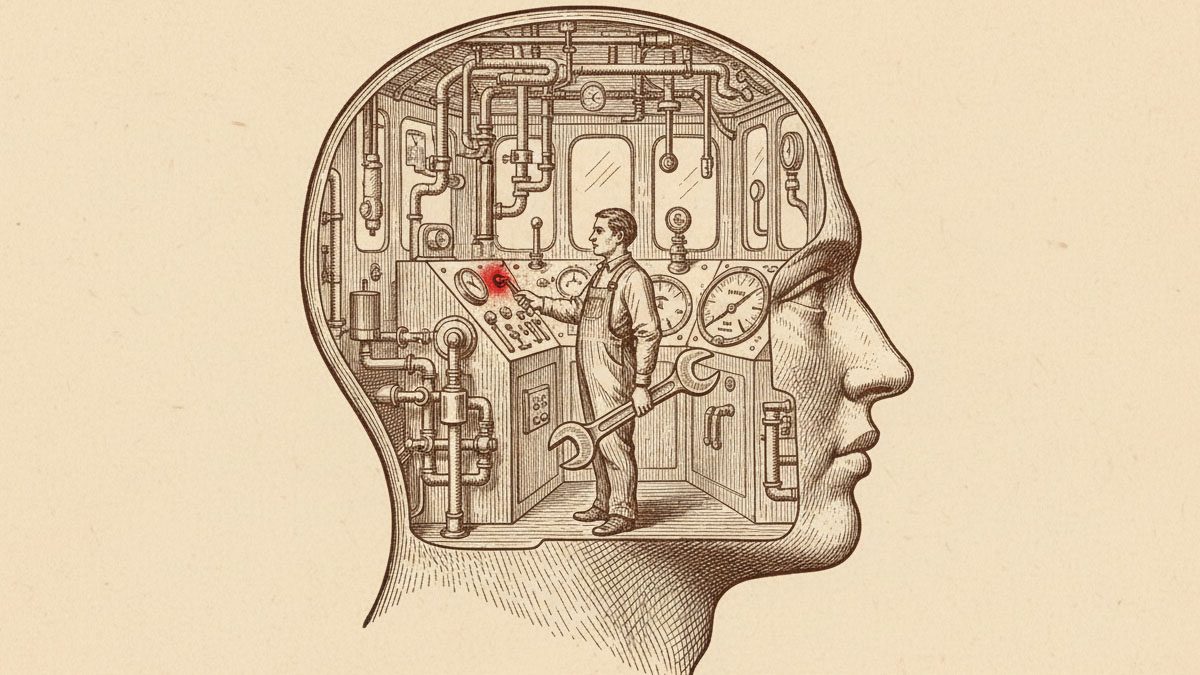
To understand what's happening to your gut, try looking at it through an engineer's eyes.

Digestion is an incredibly energy-intensive process. To break down a meal, your body must redirect litres of blood and vast amounts of energy to your stomach and intestines. This is your body's 'Peacetime Mode.'

But the moment you experience stress — fear, anxiety, anger — your brain declares 'War Mode' (Fight or Flight). This ancient survival mechanism was never designed for modern life, and it misfires constantly. (For a deeper look at the mechanics of stress, see the Complete Guide: How to Stop Being Anxious.)

In that moment, the body has one priority: survive. And to survive — to outrun a predator — you need your leg muscles and sharp senses, not a working digestive system.

What does the control system (your brain) do?

Engraving of a watermill stopped without water — metaphor for digestion shutting down during stress.

It performs an 'emergency shutdown' of the gastrointestinal tract. Blood flow to the stomach drops sharply, sphincters go into spasm, and enzyme production halts.

Psychosomatic stomach problems are not a disease of the organ itself. They are the result of your gut operating in 'power-cut mode' for years on end. And the stomach isn't the only target. For a full map of how emotions manifest in the body, see Psychosomatic Illness: The Emotions-Body Chart.

Nervous Stomach vs IBS vs Gastritis:
What Your Symptoms Could Mean

Table: 'Food Poisoning or Psychosomatic Reaction?'

Symptom
🦠 Infection / Food Poisoning
🧠 Nervous Stomach (Stress-Related)

Linked to a specific event

No clear link (or occurs after eating).

Clear pattern: before an exam, a meeting, or stuck in traffic.

Night-time symptoms

Pain wakes you during the night.

You sleep fine at night (brain rests = gut rests).

Temperature

Often elevated.

Normal, though cold sweats may occur.

Weekend effect

Still painful on Saturday.

Symptoms disappear on weekends and holidays ('Monday morning syndrome').

What science says:

'Gut feeling is not a metaphor. It is a real signal travelling from your intestines to your brain. When you sense that something is off, your Enteric Nervous System has already assessed the threat — long before your rational mind catches up.'

Emeran Mayer, MD, world-leading researcher in gut-brain communication, author of The Mind-Gut Connection.

The Gut-Brain Connection:
Fight-or-Flight, Diarrhea, Nausea, and Tight Throat

Let's look at the two most common ways this system breaks down.

Scenario 1: The Stomach
(Gastritis and Ulcers)

Engraving of a person being served rocks and thorns for dinner — metaphor for the psychological inability to 'stomach' a difficult situation.

The psychological root cause:

The inability to 'stomach' a situation.

When something happens in your life that you fundamentally cannot accept, yet feel forced to endure — a job you hate, a toxic family member — your brain sends the signal: 'We cannot digest this!'

Your stomach responds literally. It goes into spasm. The acid that should be breaking down food begins to erode the walls of an empty, clenched stomach. The result is stress-induced nausea — your body physically trying to 'reject' a situation it cannot process.

The connection between your mind and your gut runs through the Vagus Nerve.

  • When you are calm, it activates Rest and Digest mode: the sphincters relax, digestive juices flow freely.
  • Under stress, this line gets 'cut'. The Vagus Nerve shuts down, muscle tone drops, and digestion grinds to a halt. Food sits in the stomach like a stone, fermenting and causing nausea.

Scenario 2: The Bowel
(Nervous Stomach and IBS)

Engraving of a hot air balloon dropping ballast to gain altitude — metaphor for stress diarrhoea as a primitive survival mechanism.

The psychological root cause:

Fear and the urge to shed tension.

In the wild, an animal fleeing a predator moves faster when it's lighter. The quickest way to drop weight in a split second is to empty the bowels.

Irritable Bowel Syndrome (IBS) from a psychological perspective is this ancient 'dump the ballast' mechanism in action. Before an important meeting, you feel afraid. Your brain screams: 'Danger! We need to run! Drop everything unnecessary!' And you do run — not from a predator, but straight to the bathroom.

How to Calm a Nervous Stomach:
Body Awareness and Nervous System Regulation

Engraving of a clenched fist slowly opening — metaphor for a technique to release a spasming organ.

You've been trying to treat your gut with diet. But what actually needs treating is your alarm system.

1. Recognise the connection.

In the moment of a spasm, ask yourself: 'What situation am I struggling to stomach right now?' or 'What fear am I desperate to get rid of?' Simply naming the emotion releases half the tension.

2. The 'Open the Fist' technique.

Imagine your clenched, spasming stomach as a tightly closed fist. You cannot force it open with willpower. But you can feel that tension. Turn your full attention toward it. Stop fighting the spasm. Allow it to simply be there.

3. Switch modes.

Your goal is to send your brain the signal: 'All clear — stand down.' Only then will it restore blood flow to the digestive system. Use deep belly-breathing techniques or redirect your attention to objects in your external environment.

Rebooting Digestion:
Belly Breathing

The physical switch: this is the only way to quickly activate the Vagus Nerve.

Once your gut is in knots, your thoughts won't help. You need to mechanically engage the Vagus.

The technique:

  1. Place your hand on your navel.
  2. Inhale so that only your belly expands (your hand rises), while your chest stays completely still.
  3. Exhale very slowly — making the out-breath twice as long as the in-breath.

How it works:
The movement of the diaphragm massages the Vagus Nerve. The brain receives a signal: 'We're breathing deeply — there's no tiger.' The tension releases within 2–3 minutes.

  • 'Stress-induced diarrhoea is a common companion of Panic Attacks, as the body sheds ballast to prepare for flight.'
  • 'Chronic gastritis is often linked to Muscular Armour around the diaphragm, which compresses the stomach.'
  • 'The stomach is not the only target. See the full map of affected organs in the article Psychosomatics of Disease.'

What to Do Right Now:
Quick Relief Techniques for Anxiety Stomach Pain

Your gut is the most sensitive barometer of your inner state. It starts sounding the alarm long before your mind catches up.

In the Lesson 'Your Body's Two Languages: Signals of Discomfort and Pleasure' you will learn:

  • How to tell the difference between your body speaking through pain and speaking through pleasure.
  • Why we have gone 'deaf' to our body's signals — and only hear them once illness sets in.
  • How to rebuild that connection with your body, so it stops triggering the 'alarm' in the form of gastritis.

Stop reaching for antacids to numb the fear. Learn to understand what your body is actually telling you.