Mind Yoga:
Train Your Thoughts as Deeply as Your Body

Author: Alex Guru | Reading time: 6 minutes

Engraving of a yogi with a crystalline structure inside the mind — metaphor for uniting physical and mental discipline in yoga practice

You roll out your mat regularly. You know the difference between Downward Dog and Cobra. You've learned to breathe from your belly and hold a plank. After class, you feel light, calm, and at peace.

But then you leave the studio, get in the car — and the first traffic jam or rude driver instantly knocks you off balance. Your calm evaporates in 30 seconds, and suddenly there's a flash of anger. The mental noise cranks back up, and the body you just spent an hour relaxing tightens back into a knot of stress.

Why does this happen? Because you're only training half the system.

In classical tradition, Raja Yoga (the yoga of the mind) always walked hand in hand with Hatha Yoga (the yoga of the body). But in the modern world, we kept the fitness and replaced the inner work with vague spiritual fantasies.

I'd like you to look at mental discipline not through the eyes of a mystic, but through those of an engineer. Your mind needs its own 'asanas' — clear algorithms for managing attention, so you can stay flexible and grounded not just on the mat, but in real life. Here, you'll find an explanation of 'Neuro-Yoga' — ancient practices decoded through cognitive science and cybernetics. You'll understand that yoga is not a flexibility workout, but a tool for neuroplasticity.

Why Savasana Calm Disappears:
The Post-Yoga Stress Comeback

Engraving of a person bailing water from a leaking boat — metaphor for relieving stress symptoms without addressing the root cause in the mind

Many practitioners fall into the trap of 'temporary relief'.

You come to yoga to 'clear your head'. Through physical movement, you release tension and lower cortisol. In Savasana, you feel bliss. It seems like you've found your zen.

But this is a physiological illusion. You haven't solved the problem — you've simply masked the symptom.

  • Your 'mental software' (habitual thought patterns, automatic reactions of anger and resentment) remains completely unchanged.
  • The moment you step back into a stressful environment, those old programmes fire up again.

Without mental yoga, you're like someone who bails water out of a boat every day (relieving stress) but never patches the hole in the hull (the source of stress in the mind).

Mind vs Body:
Understanding Your Mental Software and Physical Hardware

Engraving of human anatomy with a punch card in the mind — metaphor for the body as 'hardware' and the mind as 'software' in a cybernetic system

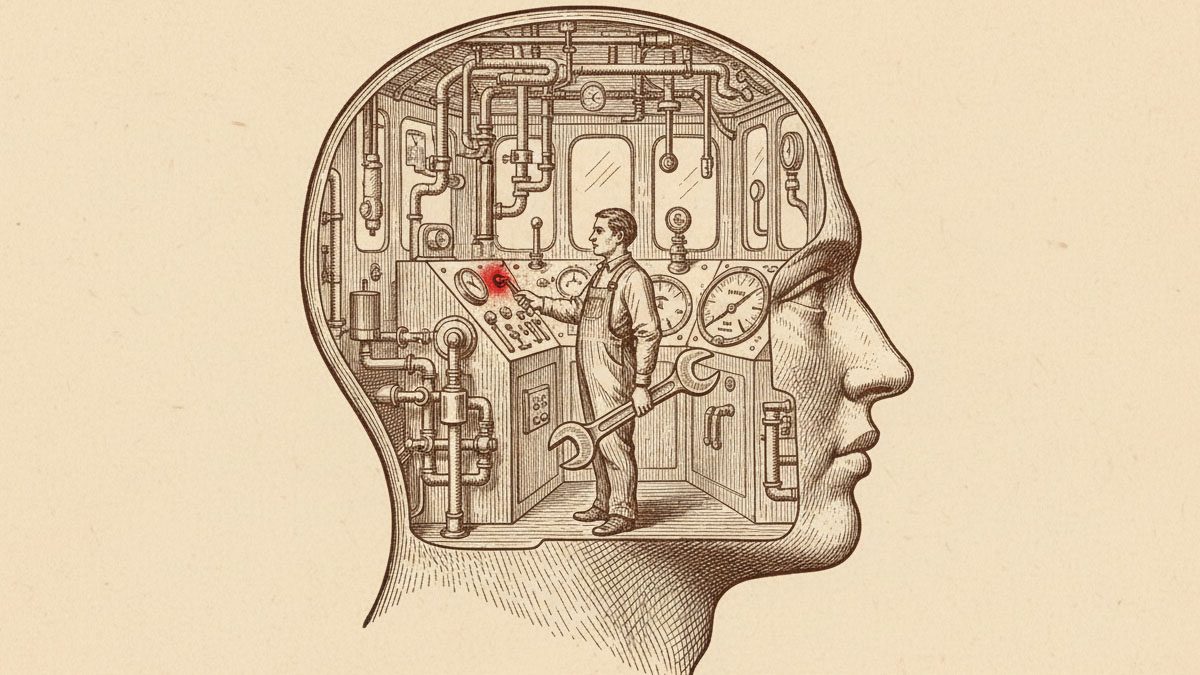
From an engineering perspective, a human being is a cybernetic system.

  1. Body (Hardware): 
    The physical infrastructure — muscles, nerves, the hormonal system. This is what physical yoga works with brilliantly.
  2. Mind (Software): 
    The programming — decision-making algorithms, perceptual filters, core beliefs.

The mind-body connection runs in both directions.

  • Body → Mind: 
    Relaxing your muscles calms your thoughts. (You're already doing this.)
  • Mind → Body: 
    Every negative thought instantly creates a micro-tension in the body. If you can't manage your thoughts, you'll be tightening your body faster than you can relax it. This is the mechanism behind muscular armour and psychosomatic illness, which we've explored in a dedicated article.

Raja Yoga practices in their modern, adapted form are not about sitting in lotus pose for years. They are an 'engineering approach' to debugging your own software.

Cortical Thickening — this is Harvard University's key scientific finding, demonstrating that mental yoga physically changes the structure of the brain.

Can yoga upgrade the brain's 'hardware'?

Neuroscientist Sara Lazar proved through MRI imaging that people who practise mental yoga (meditation and mindfulness) experience measurable thickening of the cerebral cortex.

  • Regions responsible for attention and emotional regulation grow denser (more neurons).
  • The amygdala (the brain's fear centre) physically shrinks.

Conclusion:
Mental yoga is not a metaphor. It is a genuine hardware upgrade for your brain. You are literally building 'muscle' in the zones responsible for self-control.

What Are You Actually Training:
Flexibility, Nervous System, or Mindset

The table below shows the difference between fitness and the engineering of consciousness.

Table: 'Hatha Yoga vs Raja Yoga'

Parameter
🧘‍♂️ Hatha Yoga (Body / Hardware)
🧠 Raja Yoga (Mind / Software)

Tool

Asana (Physical Pose).

Dharana (Concentration).

Goal

Joint flexibility and physical endurance.

Cognitive flexibility and stress resilience.

Result

A healthy, pain-free back.

A 'cool head' in a crisis.

What we train

The muscular core.

The prefrontal cortex (Willpower).

Effect

Temporary cortisol relief.

Lasting control over reactions.

The Hidden Mistake:
Expecting Your Mind to Fix Itself Automatically

Many people assume:

'If I keep working on my body long enough, my mind will settle on its own.'

This is a mistake.

You can have perfect flexibility, nail the splits, and still be a hostage to emotional turbulence and toxic relationships.

Physical flexibility does not guarantee mental flexibility. Muscular strength does not guarantee strength of will. These are separate skills — and they require separate tools.

Mental Asanas:
Yoga Practices for Focus, Emotional Control, and Clarity

In the 'Consciousness Workshop', we offer specific mental training practices that complement your physical yoga perfectly.

1. Mental Balance
(Instead of Tree Pose)

Engraving of a tightrope walker maintaining balance under fire — metaphor for mental stability and resilience under stress

In yoga, you learn to hold your balance on one leg. In mental engineering, you learn to hold your balance when you're hit with criticism or overwhelmed by problems.

The tool: 
The 'Witness' technique. You learn to observe your emotions from a step back — like watching clouds pass through the sky. It resembles meditation, but with an active element. (To understand the difference between passive contemplation and active mental management, read the article Meditation vs The Engineering Approach.)

2. Mental Flexibility
(Instead of the Splits)

Engraving of a sculptor softening stone — metaphor for developing cognitive flexibility and releasing rigid beliefs

The body stiffens without movement; the mind stiffens without questioning its beliefs.

The tool: 
Working with 'Mind Viruses' (Dogmas). You learn to stretch your perception — opening up to other points of view and releasing rigid 'right/wrong' judgements.

3. Mental Strength
(Instead of the Plank)

Holding a plank demands muscular effort. Holding your attention on what's positive demands mental strength.

The tool: 
'Generating Joy'. You deliberately engage the 'muscle' of attention to shift from negativity to positivity — even when everything in you wants to complain.

The Exercise:
'The Mental Plank'

Practice: 'The Mental Plank' (Cognitive Control) — a concrete, actionable exercise.

How to strengthen willpower (attention)?

  1. Sit completely still.
  2. Choose one dull object to focus on (a spot on the wall).
  3. Hold your attention on it for 2 minutes.
  4. Every time your mind wanders — gently bring it back.

Each 'return' of attention is one 'rep' for your Anterior Cingulate Cortex — the brain's centre of willpower.

Concept: 'The 8 Limbs as a Technology Stack'

The ancient manual for the human being (the Yoga Sutras) describes an 8-level system:

  1. Yama/Niyama: Social security protocols (Ethics).
  2. Asana: Hardware maintenance (Body).
  3. Pranayama: Power management (Breath).
  4. Pratyahara: Disabling unnecessary inputs (Sensory withdrawal).
  5. Dharana: Laser focusing (Attention).

The modern mistake:
We took only step 2 (Asanas) and wonder why the whole system keeps crashing.

How to Combine Yoga, Breathwork, and Mind Training in Daily Life

You don't need to give up yoga. Quite the opposite. An 'engineering approach' will make your practice ten times more effective.

  1. On the mat: 
    You feel tension in your body and recognise — it's not just a 'tight muscle', it's the physical expression of your fear or chronic over-responsibility (psychosomatics).
  2. In daily life: 
    You use the focus and concentration developed in practice to keep your attention on your goals, not your fears.

True yoga of the mind is when you stop being a puppet of your own reflexes. You become the Engineer who governs both the hardware and the software.

Key term: The Vagus Nerve — the physiology of calm.

Yoga works by activating the vagus nerve.

  • When you breathe slowly and consciously (Pranayama), you send a safety signal directly to the brain stem.
  • This is the only way to deliberately switch your nervous system from 'Fight or Flight' mode into 'Rest and Restore' mode.

Start Today:
A Simple 10-Minute Mind Yoga Routine for Beginners

You already know how to work with your body. Now it's time to understand how your body responds — moment by moment — to your thoughts and emotions. Grasp the mechanics of this process, and you'll stop fighting battles you can never win.

Explore the fundamental law of mind-body interaction in the free Lesson: The Unbreakable Bond Between Body and Mind: How Your Emotions Shape Your Body (and Vice Versa).

This is the 'theoretical foundation' of your yoga — without it, your practice will always be incomplete.