Meditation vs Mind Hacking:
A Faster Way to Calm Anxiety

Author: Alex Guru | Reading time: 7 minutes

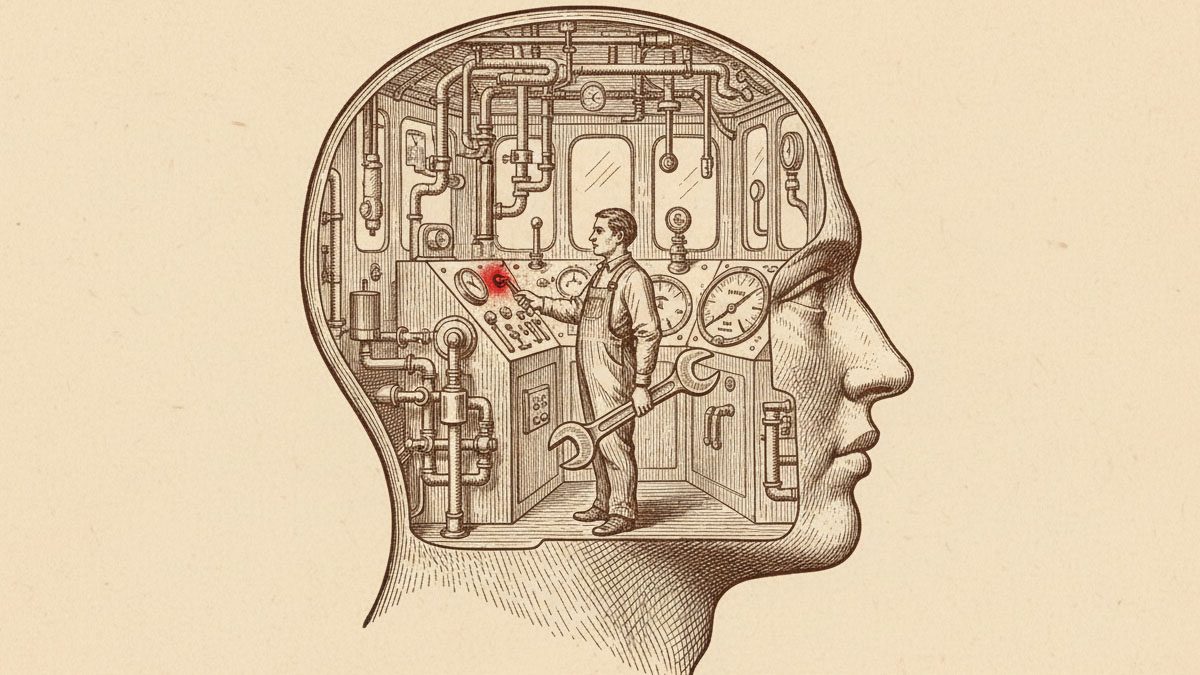
Engraving of a monk meditating by a river and an architect building a dam — comparing passive meditation with an active engineering approach to the mind

Meditation has gone mainstream. Everyone recommends it — from lifestyle bloggers to Silicon Valley CEOs. The advice is always the same: 'Sit down, close your eyes, follow your breath, and you'll find inner peace.'

But for many people with a Western, pragmatic mindset — the logical thinkers, the problem-solvers, the driven professionals — classical meditation quickly becomes an ordeal. You sit there for 20 minutes trying to 'empty your mind', while your brain runs through your entire to-do list. You feel frustrated rather than peaceful. (We explored why this isn't just unhelpful but can actually make things worse under stress in our article Why Meditation Isn't Working for You — and Why Observation Can Deepen Anxiety.)

The usual response: 'You're just not trying hard enough.'
My take: 'Maybe you're simply using the wrong tool.'

In this article, we break down the fundamental difference between passive contemplation (the Monk's path) and active management (the Architect's path) — and offer a genuine alternative for those who are wired to take action.

Two Mind Training Styles:
Mindfulness Meditation vs Mental Engineering

1. The Monk's Path
(Classical Meditation)

Engraving of a mirror reflecting a storm — a metaphor for the observer stance in meditation and mindful awareness

Observation and acceptance.

You sit on the riverbank and watch your thoughts and emotions drift past like leaves on the water. You don't intervene. You allow everything to simply be.

  • Metaphor:
    You are a mirror — reflecting everything, touched by nothing.
  • Best suited for:
    Those seeking peace through detachment and stillness.
  • The limitation:
    In the middle of a crisis, or when you need to make a decision right now, passive observation isn't enough. 'Accepting' your boss's anger might be a noble act — but it doesn't actually resolve your own reaction.

2. The Architect's Path
(The Engineering Approach)

Engraving of a watchmaker repairing a mechanism — a metaphor for active engineering intervention in the workings of the mind

Analysis and redesign.

You don't just watch the river. You build a dam, redirect channels, install turbines. You intervene in the process. When a negative emotion arises, you don't simply 'observe' it — you eliminate it or transform it into something useful.

  • Metaphor:
    You are a developer who has found a bug in the code and fixes it.
  • Best suited for:
    Those who live active, results-driven lives and want their mind to function with the precision of a finely tuned machine.

Neuroscience: The difference between the Monk and the Architect isn't merely philosophical — it reflects two distinct directions of signal processing in the brain.

Neuroscientists identify two main types of emotional regulation:

  1. Bottom-Up (The Monk's Path):
    You work through the body — breath, muscle relaxation — to calm the brain's ancient structures (the Amygdala). This is a slow route.
  2. Top-Down (The Architect's Path):
    You engage the Prefrontal Cortex (the seat of logic and willpower) to send a suppressing signal downward into the limbic system.

Classical meditation typically works from the bottom up. The Engineering Approach uses your most powerful asset — your intellect (the Cortex) — to immediately override the chaos from the top down. For people with a highly developed rational mind, the Top-Down pathway is biologically more natural.

Why the Mental Engineering Method Reduces Stress Faster

Comparison of a person standing in the wind versus a windmill harnessing it — a metaphor for transforming the energy of anger into a useful resource

When you search for mindfulness techniques, you constantly encounter the advice to 'let go of control.' But for action-oriented people, control isn't the problem — it's the very tool that gets things done.

The Engineering Method (which we teach in the 'Mind Workshop') doesn't ask you to become a Buddhist. It harnesses the skills you already have — logic, analysis, and focused intention — and applies them to your inner world.

Case Study:
Working with Anger

Engraving of a lotus flower — symbol of the Eastern approach, classical meditation, and passive contemplation.

The Monk

'I feel anger. I watch it arise and pass away. I breathe.'

Engraving of a drafting compass — symbol of the engineering approach, precise calculation, and actively designing your inner state.

Accumulation Mode

'System overheating. Root cause — boundary violation. Activating the 'Fire Extinguisher' protocol. Redirecting attention to a restorative mental image. Cortisol levels reduced. System stable.'

The key difference is that the Architect changes their state here and now, using a specific algorithm — rather than waiting for things to 'sort themselves out'.

Code visualisation: The decision-making process expressed as pseudocode.

< > Python

IF (Emotion == "Anger"):

  • STATUS = "Alert"
  • ACTION 1 = Stop_Reaction() // Do not lash out
  • ACTION 2 = Analyze_Source() // Whose boundary was crossed?
  • ACTION 3 = Execute_Fix() // Remove the cause or redirect attention
  • RESULT = "System Stable"

ELSE:

  • Continue_Life()

Unlike the Monk, we don't simply observe the variable Emotion. We run a processing function.

Meditation vs Mental Engineering:
Side-by-Side Comparison Chart

A clear side-by-side breakdown of each method's key characteristics.

Table: 'Method Specifications'

Parameter
🧘 The Monk's Path (Passive)
👷‍♂️ The Architect's Path (Active)

Goal

Nirvana / Peace / Stillness

Efficiency / Results / Clarity

Primary tool

Observation, Breathwork

Analysis, Pattern interruption, Reframing

Response time

20–40 minutes (a full session)

3–30 seconds (in the moment)

Relationship to emotion

'Let it float by like a cloud'

'This is a bug — fix it'

Ideal for

Holidays, retreats, winding down before sleep

Negotiations, deadlines, conflict situations

Signs You Think Like a Mind Architect (Not a Meditation Monk)

Who may find classical meditation counterproductive?

Traditional meditation can genuinely frustrate you if you have this type of mindset:

  • High need for control:
    Letting go of the outcome feels physically uncomfortable — you're someone who takes responsibility for results.
  • Fast-moving mind:
    Your brain generates a hundred ideas a minute, and trying to 'stop the flow' feels like going against your very nature.
  • Pragmatic outlook:
    You struggle with activities that don't produce a measurable outcome ('Why am I just sitting here breathing?').

If that sounds like you — stop forcing yourself into the lotus position. Use tools built for the way your mind actually works.

From Mindful Observer to Mind Engineer:
The Step-by-Step Shift

In our course 'The Physics of Consciousness', we explain that passive observation is only the first step — it's the data-gathering phase. But data only has value when you use it to draw conclusions and change the system.

The Engineering Approach involves:

  1. Diagnosis:
    Precisely identifying what you are actually feeling, using an intensity scale.
  2. Analysis:
    Understanding the mechanics behind the emotion — which underlying belief triggered it?
  3. Intervention:
    Applying a specific technique to shift your state (for example, 'Elimination' or 'Pollination').

This is active, deliberate inner work that produces measurable results. You're not just 'meditating' — you're debugging and upgrading your own mind. If this approach resonates with you, we recommend reading our manifesto: Psychology for Analytical Thinkers: A User Manual for the Brain.

The Engineering Approach is not a modern invention — it's a rediscovered classic: Stoicism.

The Roman Emperor Marcus Aurelius didn't meditate on flowers. He governed an empire in a state of near-constant war. His method — Stoicism — is the direct ancestor of the Engineering Approach.

'You have power over your mind, not over outside events. Realise this, and you will find strength.'Marcus Aurelius.

We have simply translated these ancient principles into the language of modern neuroscience.

How to Start Today:
Quick Stress Relief Exercises to Try Now

If classical meditation leaves you bored or frustrated, don't be too hard on yourself. You may simply be an Architect who's been told to sit on their hands.

  • «The Architect's default mode is the Impartial Observer — someone who reads the instruments rather than panics».
  • «Instead of 'breathing through' conflict in the moment, use the interruption protocol from the article Anger Outbursts».
  • «The Monk seeks support from the Universe; the Architect builds their own Inner Core».

In Course 1 'Freedom from Suffering' we offer exactly these kinds of practical, engineer-minded tools for managing your inner state. No esotericism, no mantras, no incense — just the mechanics of consciousness.

Start by running a diagnostic on your own system.