How to Stop Fighting in a Relationship and Communicate Calmly

Author: Alex Guru

Engraving of a couple at a table with shadows fighting — metaphor for hidden aggression and ego battles in relationship arguments.

Does this sound familiar? A throwaway comment spirals into an hour-long screaming match. You never meant to raise your voice, but it happened anyway. You try to make your point, and all your partner hears is blame. Afterwards — emptiness, shame, and the same haunting question: 'Why do we keep doing this?'

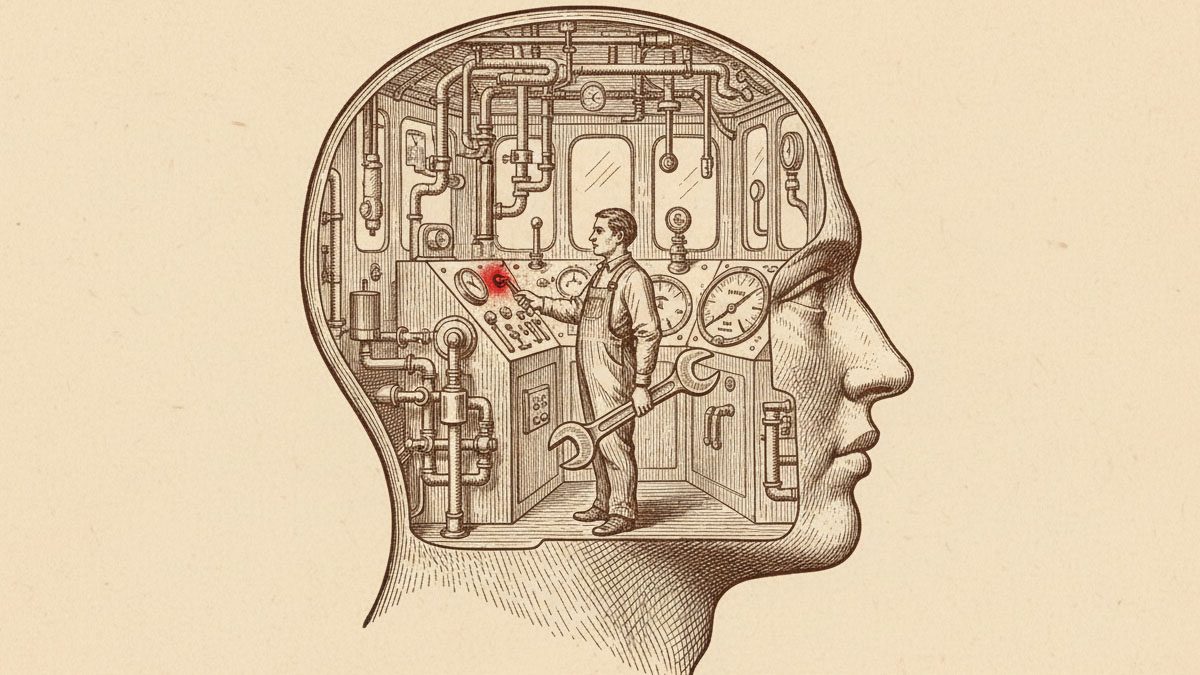
Recurring conflict in a relationship is not a sign of incompatibility. It's a sign that your mind is running on emergency autopilot.

At the 'Consciousness Workshop', we don't teach you to smooth things over. We teach you to understand the mechanics. An argument turns into a war the moment an ancient biological script kicks in — what we call the 'Attack Response'. While you're locked inside that script, constructive conflict is simply not possible.

In this article, we'll break down exactly how this destructive mechanism works, why your brain defaults to aggression, and how to flip the switch from 'war' to 'dialogue'. You'll discover that arguments aren't about having a 'bad temper' — they're about a physiological state called Flooding (DPA), in which a person literally cannot process what they're hearing. Drawing on family science (the Gottman Institute) and communication theory, you'll learn that we shout at each other not because we're bad people, but because our heart rate has hit 120 bpm and we've fallen into an attribution trap — and the fix is simply to introduce a pause protocol.

Why Your Brain Goes Into Fight-or-Flight During Arguments

Engraving comparing bellows fanning flames with a sealed flask — metaphor for the Attack response (release) and Retreat response (suppression) in conflict.

From a consciousness engineering perspective, every negative emotion is a signal that something has gone wrong. But that signal can take two opposite forms (explored in detail in the Lesson 'Two Faces of Negativity'):

  1. Retreat:
    Energy turns inward (resentment, guilt, apathy). You want to shrink and disappear. This is the classic pattern of people with weak personal boundaries (read more in the article How to Stop Being a People-Pleaser).
  2. Attack:
    Energy turns outward (anger, irritation, accusations). You want to eliminate or change the source of your discomfort.

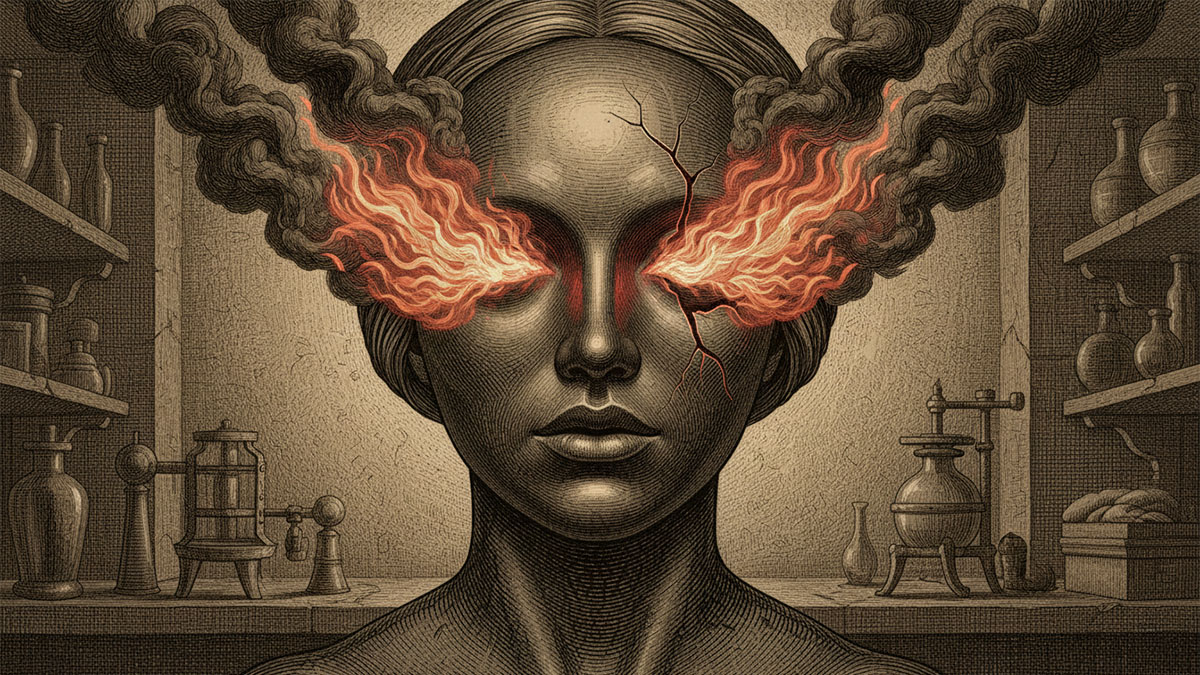
When you search for ways to stop fighting with your partner, what you're really looking for is a way to switch off Attack Mode.

How it works:

Your brain reads the situation — say, socks left on the floor or someone running late — as a threat to your order or sense of authority. Instantly, the survival programme fires: 'Fight!' Adrenaline floods your bloodstream. In that moment, your only goal is not to find common ground or reach the truth — it's to defeat the threat. (We explored how brain chemistry shuts down rational thinking in under three seconds in the article Anger Outbursts: Why You Snap.)

Your partner is no longer the person you love. They become an 'object' that needs to be corrected — or destroyed (emotionally).

The Flooding Effect (DPA) is the gold standard in couples therapy, developed by Dr John Gottman.

Why does your partner seem to 'stop hearing you' during an argument?

John Gottman — the researcher who can predict divorce with 94% accuracy — calls this Flooding, or DPA (Diffuse Physiological Arousal).

  • When your heart rate during a conflict climbs above 100 beats per minute, your body releases a surge of adrenaline.
  • The result:
    The prefrontal cortex (the part responsible for logic) shuts down. Your auditory processing narrows to a tunnel. You physically lose the ability to take in complex information or feel empathy.
  • The takeaway:
    Trying to have a meaningful conversation with someone in a state of DPA is like trying to run advanced software on a pocket calculator. It's technically impossible. The only solution is a 20-minute pause — the time it takes for adrenaline to metabolise.

Gottman’s Four Horsemen:
The Conflict Patterns That Predict Breakups

The 'Four Horsemen' framework is Gottman's landmark classification system — a powerful diagnostic tool for identifying how far down the road of relationship breakdown you really are.

Table: 'The Four Horsemen of the Apocalypse'

☠️ Horseman (The Problem)
🗣️ Example Phrase
🛡️ The Engineering Antidote

Criticism (Attacking the person, not the behaviour)

'You're always late! You're so selfish.'

I-statement: 'I feel upset because we were late.'

Contempt (Sarcasm, eye-rolling)

'Oh right, poor you — so exhausted, are we?'

Build a culture of appreciation: Recall what you genuinely respect and value in your partner.

Defensiveness (Making excuses)

'It wasn't my fault — the traffic was awful! And anyway, you always...'

Take responsibility: 'You're right, I was late. I'm sorry.'

Stonewalling (Shutting down / silent treatment)

Going silent, leaving the room.

Call a pause: 'I'm overwhelmed right now. Can we pick this up in 20 minutes?'

The Righteous Anger Trap:
When “Being Right” Destroys Connection

Engraving of a man burning down his house to kill a mouse — metaphor for a disproportionate anger response destroying a relationship over something trivial.

The most insidious thing about the Attack script is how justified it makes you feel.

The scenario:

Your partner forgot to pick up groceries.

The Attack response:

'You never listen to me! You don't care about this family at all!'

What's happening:

You feel a rush of energy. Anger feels like power. It seems as though you're finally standing up for yourself and restoring fairness.

The reality:

You're not solving the problem of what's for dinner. You're attacking your partner's character. Their defence system automatically triggers a counter-Attack or a full Retreat. The dialogue is over. The war has begun.

The question of how to control anger in an argument comes down to one insight: your sense of 'being right' in that moment is a hallucination generated by an inflamed ego. It's nothing more than a biochemical reaction to discomfort.

The Emergency Stop Method:
How to De-escalate Before You Say Something Hurtful

You cannot simply forbid yourself from feeling anger. But you can stop it from taking the wheel and driving your words and actions.

Step 1.
Diagnose It (Label It)

The moment you notice your voice rising and a familiar urge building — the need to 'set them straight once and for all' — give yourself a mental stop signal.

Say to yourself: 'Attack Mode has kicked in.'
This one act shifts you from 'I am angry' to 'I am observing anger' — and that small distance makes all the difference.

Step 2.
Separate the Fact from the Story You're Telling

Engraving of a fly that looks like a dragon under a microscope — metaphor for turning a small fact into a catastrophe through interpretation.

The fact: 'There's no milk.'

The Attack (interpretation): 'He doesn't love me and doesn't care about anything I need.'

Strip away the interpretation. Stay with the fact. (Our own assumptions and mental narratives are often the real source of drama — explore this further in the article Why We Fall in Love with a Fantasy.)

Attribution error:

Why do we cast our partner as the villain?

  • When I make a mistake (arrive late) — it's circumstances ('the traffic was terrible').
  • When THEY make a mistake (arrive late) — it's their character ('they're so irresponsible').

We judge ourselves by our intentions, but others by their actions. This glitch in our thinking has to be switched off manually.

Step 3.
Call a Technical Timeout

Engraving of a knight sheathing his sword and walking away — metaphor for choosing to pause rather than escalate a conflict.

Don't try to 'sort everything out right now'. In Attack Mode, you are only capable of causing damage.

Say this:
'I've hit my limit and my emergency mode has switched on. I need 10 minutes to come back to myself. Then we can talk.'

The Safety Rule:
The 'Stop Word'

Agree on a code word with your partner during a calm moment — something like 'Time out' or 'Pause'.

  • If either person uses it, the argument stops immediately and unconditionally.
  • Both of you go to separate spaces.

One essential condition:
You must return to the conversation within 24 hours. The pause is not a way to bury the issue — it's a way to let your nervous system cool down so the real conversation can actually happen.

The Framework:
The XYZ Formula (NVC Script)

Practice: The NVC Protocol (Nonviolent Communication Script) — a formula developed by Marshall Rosenberg.

How do you raise a difficult issue without starting a war? Use Rosenberg's script:

  1. Observation (The Fact): 'When I see dirty dishes in the sink...' (No judgement — no 'this place is a pigsty').
  2. Feeling: '...I feel irritated and drained...'
  3. Need: '...because a tidy space and some downtime really matter to me.'
  4. Request: 'Would you be able to wash them up before this evening?'

This formula contains no 'YOU' — no accusations. Only observable facts and your own feelings. And nobody can argue with how you feel.

  • 'Criticism and contempt are forms of Anger Outbursts, triggered by an amygdala hijack.'
  • 'Defensiveness often arises where Personal Boundaries have been violated and a person feels under attack.'
  • 'Interpreting facts as intentional ('they're doing this on purpose') is the work of Cognitive Traps that distort reality.'
  • 'If your partner consistently uses conflict as fuel — constantly provoking arguments — you may be living with an Energy Vampire.'

Start Today:
A 5-Minute Reset to Create Safer, Healthier Communication

To stop damaging your relationship, you first need to understand which stress-response script feels most like 'home' to you. Are you the one who attacks — or the one who shuts down and withdraws?

This is fundamental self-knowledge. Without it, genuine self-regulation simply isn't possible.

Discover your response type in the Lesson: Two Faces of Negativity: Attack or Retreat?

Understanding your own script is the first step to breaking free from it.