Energy Vampire Relationships:
Signs, Causes, and How to Protect Yourself

Author: Alex Guru | Reading time: 5 minutes

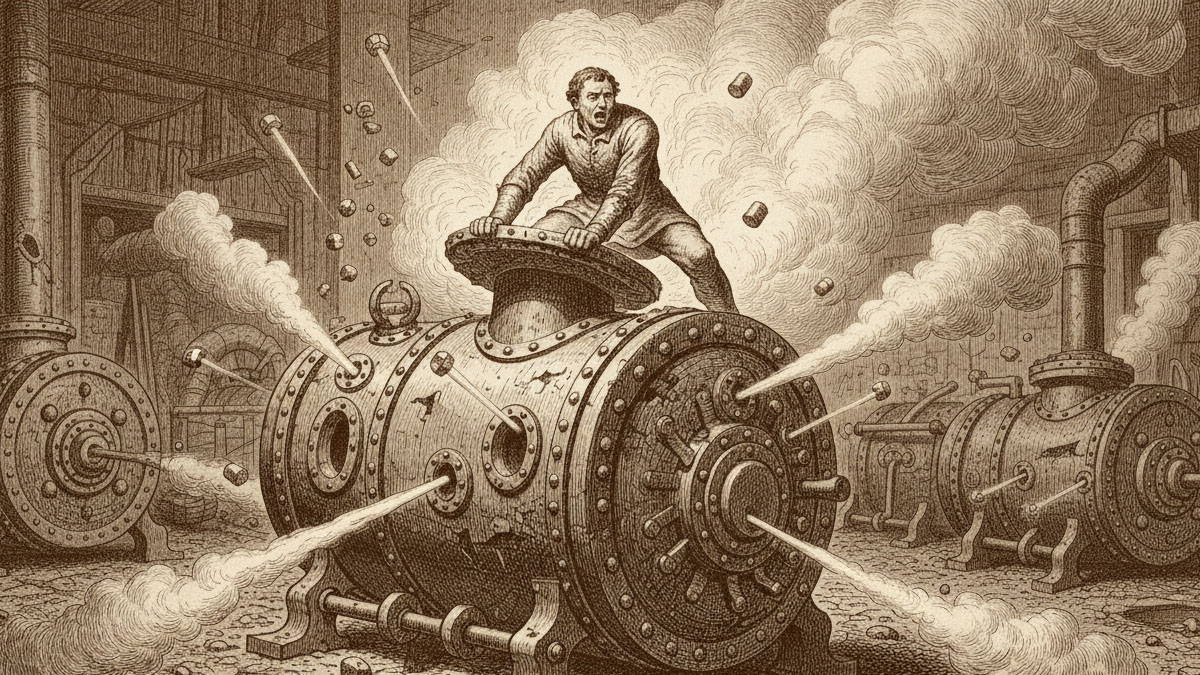
Engraving of a couple connected by a hose through which energy drains away — metaphor for energy dependency in relationships.

You come home from work hoping to unwind, but within an hour you feel as though you've run a marathon. Talking to your partner leaves you exhausted. Their very presence feels heavy. You find yourself searching: 'husband energy vampire' or 'how to protect yourself from a draining wife.'

It seems like your partner is a black hole, consciously feeding off your life force.

As someone who thinks like an engineer, let me invite you to set the mysticism aside. Your partner isn't drinking your blood or tapping into some cosmic channel. Energy vampirism in a relationship is a technical problem within your own energy exchange system. You're not losing energy because someone is stealing it — you're losing it because you're voluntarily bleeding it out through the gaps in your own boundaries.

In this article, we'll break down the mechanics of emotional exhaustion in a relationship and track down the real culprit — who lives, as it turns out, inside your own head. You'll discover that 'vampirism' isn't about drained auras; it's about cognitive dissonance and the glucose your brain burns suppressing your natural reactions. You'll understand that your partner isn't a sorcerer — they're simply a trigger. The exhaustion isn't coming from them; it's coming from your own inner tension. And the good news? You can learn to let that tension go.

Axiom:

'Contact boundaries serve two functions: to separate and to connect. Without boundaries, there is no 'self.' You simply become a nutrient medium for other people's neuroses.'

Fritz Perls, psychiatrist and founder of Gestalt therapy.

Why You Feel Drained:
The Psychology and Biology of Emotional Exhaustion

Engraving of gears turning in opposite directions — metaphor for inner conflict and energy lost through resistance.

We usually blame the other person: 'He just whines all the time,' 'She's always demanding something,' 'My partner never lets up.' But let's look at what's actually happening beneath the surface.

Your energy is only depleted in one situation: when internal resistance arises. That's the friction between what you want to do and what you actually do.

Relationship fatigue doesn't come from your partner's behaviour — it comes from your reaction to it.

  1. Your partner makes a complaint or demand.
  2. You don't like it. Your natural instinct is to step back, say no, or stay quiet.
  3. But a social script kicks in: 'I should be a good partner,' 'I just need to put up with it,' 'Keeping the peace is worth it.'
  4. You override your own impulse and do what's expected — you listen, make excuses, or comply against your better judgement.

It's precisely in that moment of emotional suppression (and we explore why this is more damaging than open conflict in a separate article) that a massive amount of energy is lost into the void.

The biochemistry of exhaustion — a concrete explanation of where your energy disappears to.

Why do you feel physically drained after an argument — or even after a tense silence?

The answer lies in the phenomenon known as Ego Depletion.

Psychologist Roy Baumeister demonstrated:
Self-control — suppressing an emotion, forcing yourself to sit and listen to someone vent — burns glucose in the prefrontal cortex just as intensively as solving a complex maths problem.

The takeaway:
Your partner didn't 'drain' your energy. You burned through your own glucose reserves maintaining a mask of patience and composure. You're running on empty because your internal brakes were working flat out.

How to Spot the Source:
Boundaries, Triggers, and Relationship Burnout Patterns

People often confuse genuine emotional abuse with their own difficulty in maintaining personal boundaries. The table below helps separate these two very different sources of responsibility.

Table: 'True Vampire (Abuser) vs My Own Reaction'

Factor

🧛‍♂️ The Vampire (External threat)

🎭 Your Vulnerability (Internal threat)

Behaviour

Gaslighting, humiliation, direct insults.

Taking offence at neutral words, mind-reading.

Your reaction

Fear, the urge to shrink away.

Irritation, the urge to 'be good.'

Personal Boundaries

They deliberately break them down.

You leave them wide open ('I don't want to seem difficult').

Solution

Distance and separation.

Working on self-worth and the ability to say 'No.'

The Hidden Driver:
Unmet Needs, Attachment Wounds, and “Vampire” Dynamics

Engraving of a person feeding a wolf in sheep's clothing — metaphor for vampire desires disguised as virtues.

In our methodology (Course 2), we introduce the concept of 'Vampire Desires.' These are actions that disguise themselves as genuine wishes — 'I want to keep the family together,' 'I want to help' — but are actually driven by fear, guilt, or a sense of obligation.

It's these false desires that drain you empty — not your partner.

A True Desire (an Energiser):

You cook dinner because you genuinely want to do something nice for someone you love. The process itself gives you energy.

A Vampire Desire:

You cook dinner because 'you're supposed to' and 'they'll be upset if you don't.' You lose energy in the process — even if the meal turns out beautifully.

If ninety percent of your relationship runs on 'Vampires' — on 'must,' 'ought,' and 'just put up with it' — you will feel constantly drained, even if your partner is genuinely kind and well-meaning.

In Gestalt therapy, 'Vampire Desires' are known as Introjections.

These are other people's rules — 'You should just grin and bear it,' 'A good wife doesn't argue' — that you've swallowed whole without ever stopping to question them.

  • They work like malware:
    They conflict with your genuine needs, creating a constant background tension — a persistent noise in the system.

Common Energy-Draining Behaviors:
How People-Pleasing and Rescuing Feed It

Situation 1:
Complaining and Venting

Engraving of a person having toxic complaints poured into their ears — metaphor for the drain of compulsive listening.

Your partner spends hours offloading about problems at work. You're bored and exhausted. You want to sleep. But you tell yourself: 'I should be supportive.' So you sit there, nodding, while quietly seething inside.

Diagnosis:
You're feeding the 'Vampire' with your attention — at the cost of your own wellbeing. (This dynamic doesn't only play out in romantic relationships — it happens with friends too. Find out how to spot energy vampires in your wider circle in our dedicated guide.)

Situation 2:
Nagging and Control

You're asked to do something you really don't want to do — visit the in-laws, tackle the home renovation. You can't bring yourself to say no outright (fear of conflict). This is a classic pattern for people who have become 'people-pleasers.' You agree — but drag your feet through it or do it with barely concealed resentment.

Diagnosis:
You're burning energy maintaining a mask of compliance.

How to Stop Feeling Drained:
A Boundaries and Energy Audit for Couples

Engraving of an electrician checking wiring — metaphor for auditing your energy system and finding the source of the drain.

To stop the drain, you don't need to file for divorce or hang garlic by the door. You need to learn to tell the difference between your genuine impulses and the false ones.

1. Pause.

Next time you feel your energy dropping around your partner, ask yourself: 'What am I actually doing right now?'

2. Test it.

'Am I doing this because it genuinely energises me (an Energiser)? Or am I doing it because I'm afraid of what happens if I don't (a Vampire)?'

3. Make a choice.

If it's a 'Vampire,' your task is either to stop doing it — or to find a genuinely meaningful aspect within the process that makes it worthwhile.

Stop servicing the 'Vampires.' Your relationship should be a source of energy, not a second job.

A Practical Script:
How to Turn Off the Tap

Practice: The 'Stop Valve' Script — a concrete set of words to use in the moment. Most people struggle to set limits because they simply don't know how to phrase it.

When your partner starts venting or pushing demands, use the formula: 'I-statement + Boundary':

  • 'I can hear that you're having a tough time (Acknowledgement).
  • But I don't have the bandwidth to go into this right now (Honest fact).
  • Can we come back to it in an hour — or tomorrow? (Constructive offer)'

This isn't rudeness. This is maintaining the integrity of your own system.

  • 'Vampirism only takes hold where personal boundaries have broken down. Mend the fence, and the vampires disappear.'
  • 'Energy drains in the moment of emotional suppression — when you swallow your natural response.'
  • 'Learn more about the different types of energy vampires (the Complainer, the Critic) in our breakdown: Where Does Your Energy Go?'
  • 'Take the Vampire Test to find out how many draining programmes you're currently running on autopilot.'

Start Here Today:
Simple Scripts and Next Steps to Reclaim Your Energy

Learning to tell the difference between your genuine energy impulses and the inherited scripts of duty and obligation is the foundation not only of a fulfilling relationship, but of genuine mental wellbeing. You need to develop a feel for the quality of your own energy.

We walk through exactly how to identify a 'Vampire' in your own mind — and replace it with a real source of energy — in the free Lesson: Energising Desires vs Vampire Desires: How to Tell Your Own 'Want' from Someone Else's 'Should'.

This single insight will do more to protect you from exhaustion than months of couples therapy.